Post generated with AI tools, under the creative direction of Jesse Alexander.
It’s been a minute since I posted here, but I’ve got a good excuse, I’ve been in space.
So here’s the pitch. Ninety-nine of the worst beings in the galaxy just walked out of the most secure prison ever built. Who do you send after them?
One young human with a pencil, and five killers and misfits.
It’s called BAD APPLES: DARK CELL, The Hunt for the 99, and it’s an adult space adventure, an anthology of hunts that we’re building with comics and novels in mind too. A lot of it got built with AI tools this fall, and some of what I learned along the way is useful for any scribbler with a drawer full of old pitches, so let me walk you through it.
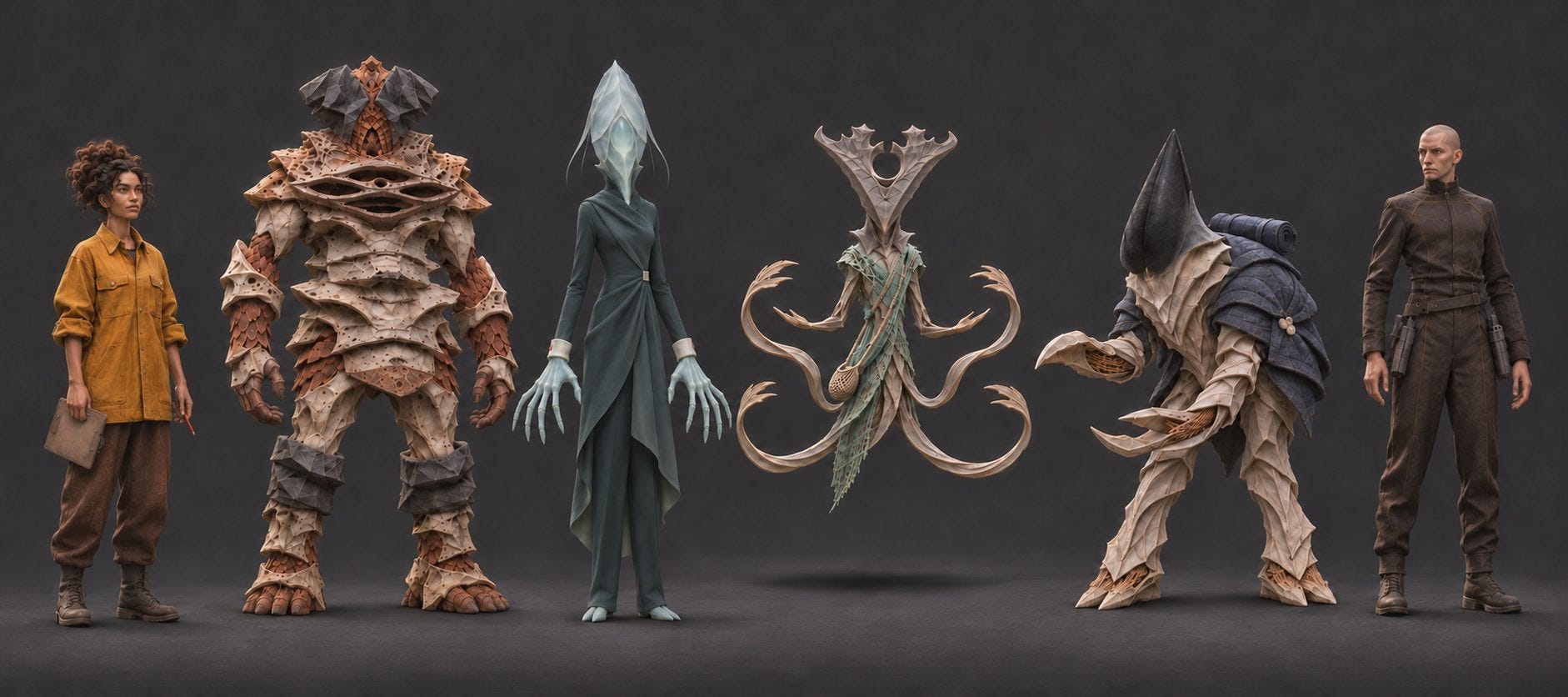
The crew of the Orchard: Abigail, Tukkar, Nym, Vesk, Lio and Kellen. Development art.
It started as a spy show
Back in 2024 BAD APPLES was a CIA thriller. A young targeting officer and a team of very bad people, built on the real-life experiences of Sarah Adams, a former CIA Targeting Officer.
This fall I pulled it back out and asked a dumb question. What if the team wasn’t human?
So we took them out of Langley and stuck them on a retired prison ship called the Orchard, parked at the edge of a black hole.
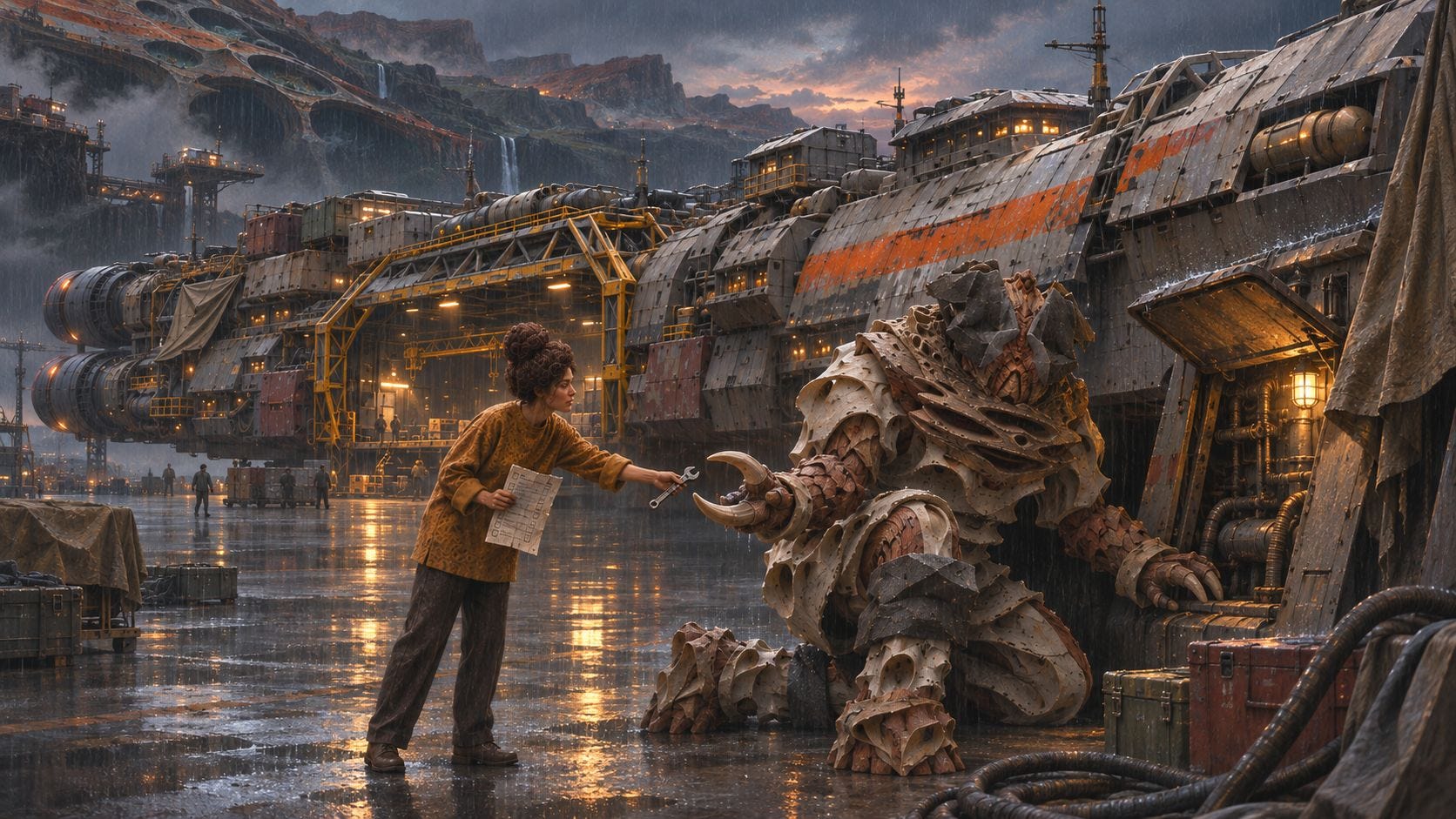
Abigail Chase, our targeting officer, stayed human, the only human on board, and everybody else got a new body.
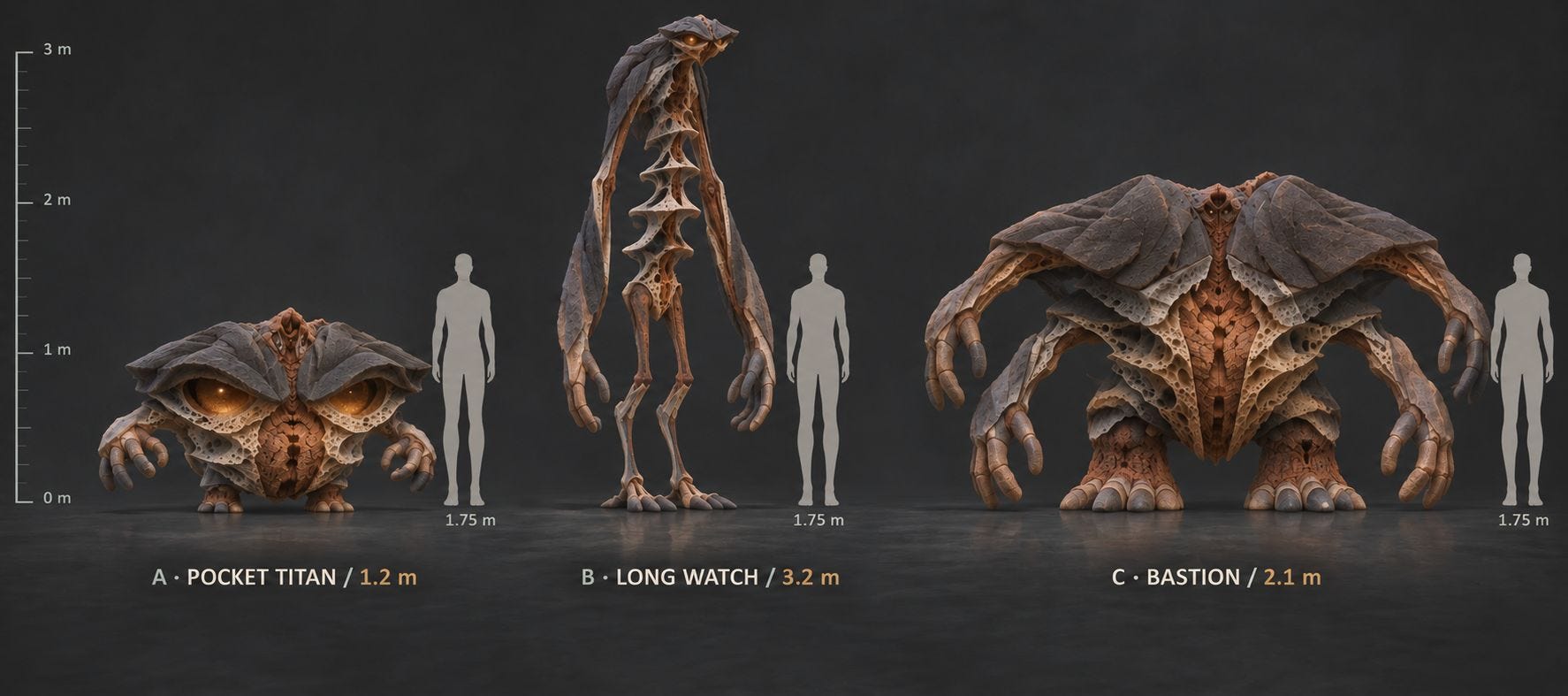
Tukkar Omdor runs the team, a Brakkan ex-marine, two point three meters of plated shoulders, and since Brakkans grow a new armor ridge for every war they survive you can read his whole career right off his body. His orders come out funnier than he knows. “Nobody lick the kaiju.” In his downtime he carves little animals out of ship scrap and gives them away.
Doctor Nym has the best manners on the ship and he’s also the most famous serial killer in the galaxy, now consulting. He’s a Vael, a people whose brains run two minds side by side, and he can’t tell you which one is him. Which scares him more than it scares you.
Vesk is an Ossari, and Ossari skin changes color with every feeling, which is a real problem when your job is assassin.
Lio flies the ship and runs the cons. His people, the Phaedrae, are born as a brood of selves in one body that are supposed to merge into one person when they grow up, and he never did.
Kellen Nine was grown in a lab, no navel, no scars, never been sick a day in his life.
The thing is, the old pitch had good bones. Abigail reads people, figures out who somebody is and what they’ll do next, and that job works anywhere, and in space it actually got better.
Every other species out there follows the instincts of its own kind, and humans don’t have that script, so the other profilers can’t read her. But she can read the fugitives like text on a page.
An old pitch can have a lot more life in it than you think.
Ninety-nine is a lot of adventures
The engine is simple. Every cell door opens at the same moment, and ninety-nine mugshots go up on a cork board in the Orchard’s galley, with one red marker hanging off it on a string, and every hunt is one name and one kind of story.
And I really do mean kind of story. Horror, spectacle, spy, madcap, road, heist, race, kaiju and mecha. Fifteen horror hunts, eight kaiju, eight mecha and everything else in between. A con artist who sold a planet a second moon and needs it to stay up through the wedding. A kaiju who believes it’s a bridge. It’s been bridging for forty years, and traffic is fine.
But ninety-nine of anything is where a story world usually falls apart. Fugitive forty starts sounding like fugitive twelve, the same sad backstory shows up six times, and suddenly everybody’s named Vex.
So before we wrote a single hunt we wrote six rules. Every hunt has to pass all six.
The Heart Rule. Every fugitive is funny in one specific way and aching in one true way. The funny gets you in the door. The ache is why Abigail writes their name down.
The Cleveland test. Could it happen in Cleveland with the nouns swapped? Then it’s out. Every scheme has to need this galaxy.
Bodies first. Every people has a body that does one strange thing, and every fugitive’s plan turns on what their body is made of.
The Say It test. Short names, spelled the way they sound, no hyphens, no apostrophes, and it has to fit on a box lid. We renamed almost everything, some of it more than once, until nobody reading it or saying it or hearing it would trip over it.
Straight dark. About one hunt in five plays dark start to finish. The jokes go at the hinges, before the danger and after the survival. Never on a death.
Back to the galley. Every hunt ends at the long table, everybody tired and hungry, and nobody leaves until the board is updated.
If you only steal one of these, steal the Cleveland test. It kills a lot of perfectly good crime stories that just happen to have tentacles. Works on any world, too, sci-fi or fantasy or a weird little town.
Does your story need your world? If it doesn’t, it’s a costume.
Then the world got galactic
Once the rules held up, the galaxy filled in fast, twenty-eight peoples across six regions, a hundred and twenty-two places and thirty-four ships.
Then a whole book about ordinary life out there, what people eat, what they watch, what they bet on and what they get buried with.
Abigail started keeping a field notebook and the crew started writing in her margins. Tukkar’s the only one who gets to cross out a name with red marker. And only when the hunt ends in capture.
That kind of breadth is where the AI tools earn their keep.
Ninety-nine log lines, a hundred and twenty-two location briefs, what somebody eats for lunch on a moon nobody visits. I set the direction, made the calls and threw out a lot, and the machines did a great deal of the drafting. My job was taste and the veto, which is pretty much my OG showrunner gig in a room anyway.
The familiar monster problem
Then we got to the art and hit a wall.
I don’t have art skills. And if you type “scary alien” into an image model you get the alien from every space movie you’ve ever seen.
Our first painted species came straight from written prompts, and sure enough they looked like everybody else’s aliens, so we pulled them.
So I went back to something I remembered from Scott Robertson’s book Alien Race, where he builds creatures out of found objects. ChatGPT helped me build a tool to try it - Alien Form Workbench.
The workbench is a digital collage tool. It uses programmed rules and randomness to cut up pictures of ordinary materials and throw them together, and then I choose what to keep and how to develop it. Here’s how Tukkar got his face.
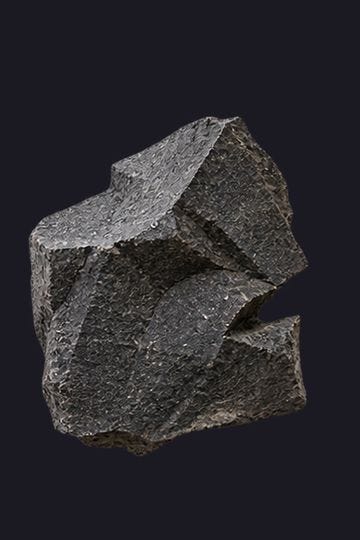
Fractured basalt, one of the seven plain materials Tukkar started from
Start with ordinary things. For Tukkar that was seven of them, silver birch bark, fractured basalt, a dry banksia pod, a split milkweed pod, a bone-like plate, pine bark and cork oak bark.
Each one is a plain material study an image model made under a strict brief, no face, no eyes, no limbs, no symmetry, because all we want is the cracks and holes and ridges. Nobody’s idea of a monster baked in.
Throw them together and write the dice down. A short script layers a few pieces at random sizes, angles and positions. Every random number gets saved as a seed, so any collage can be rebuilt exactly. Tukkar’s batch was eight collages from eight seeds.
Mirror it. Pick a line, keep one side, flip that half over. Nobody paints anything, nobody adds eyes or a mouth, and faces show up anyway, the way they do in a cracked wall.
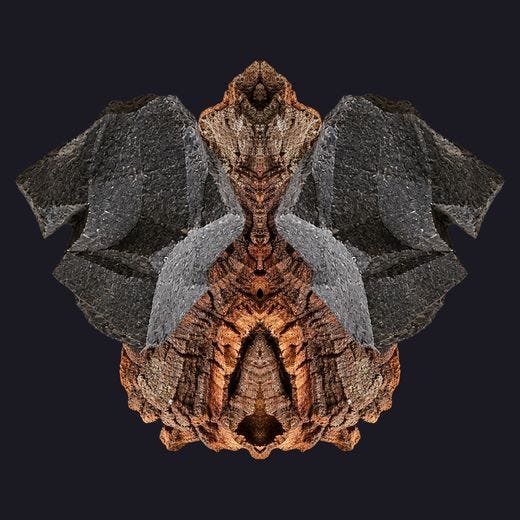
A mirrored collage, before any painting
Pick one, and keep the rest. For Tukkar I picked the paired basalt plates over the rust-brown cork, and everything else went back in the pool.
We keep every reject, because a wrong body for one people can turn out to be the right body for another, or a ship, or some gadget nobody asked for.
Grow a body from the same parts. The head stays locked in place and new bodies get built under it from the same fragments. They go anywhere from two limbs up to ten, short and wide or tall and narrow, all at one scale. Tukkar’s canonically 2.3 meters tall, so the deep barrel at his height won.
Paint over it, and keep the silhouette. Only now does the painting pass run, right on top of the collage, and it has to keep the outline, the big masses and the holes so the cut seams turn into plates and joints instead of disappearing. The weird was there before the paint showed up. The paint doesn’t get to sand it off.
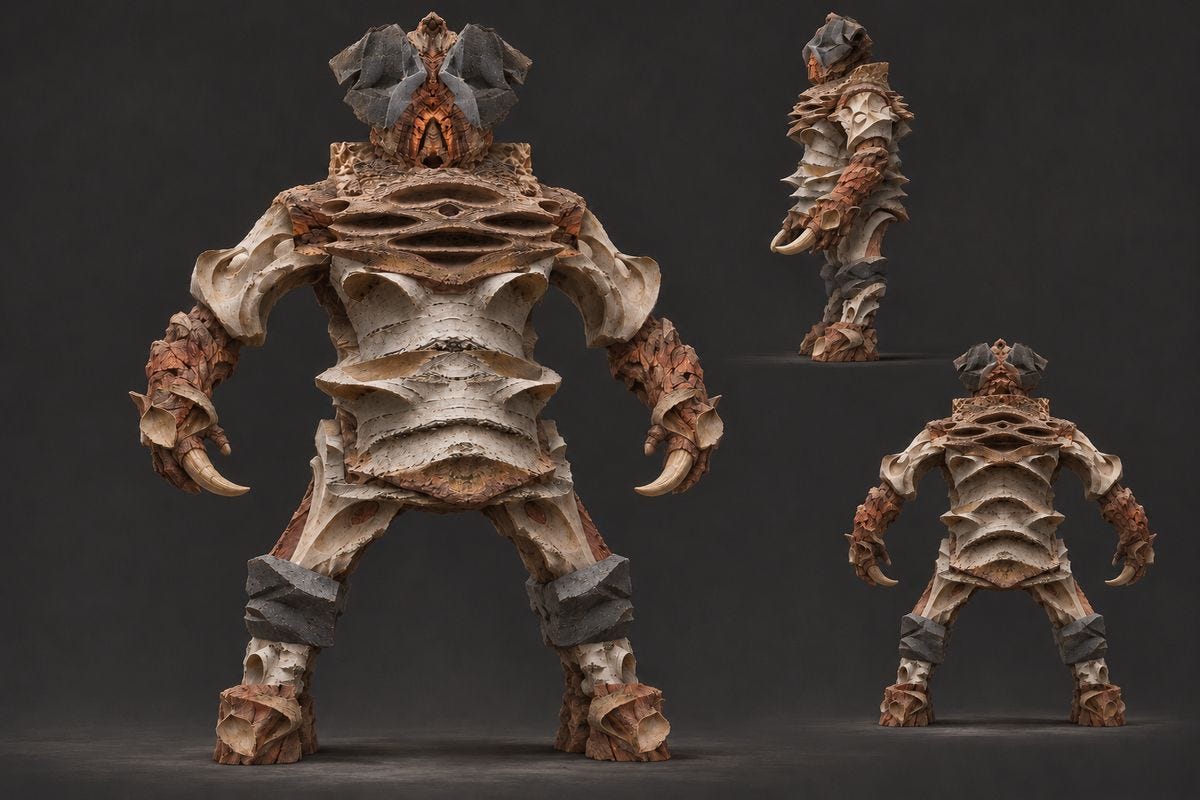
The Brakkan collage and the painted development sheet
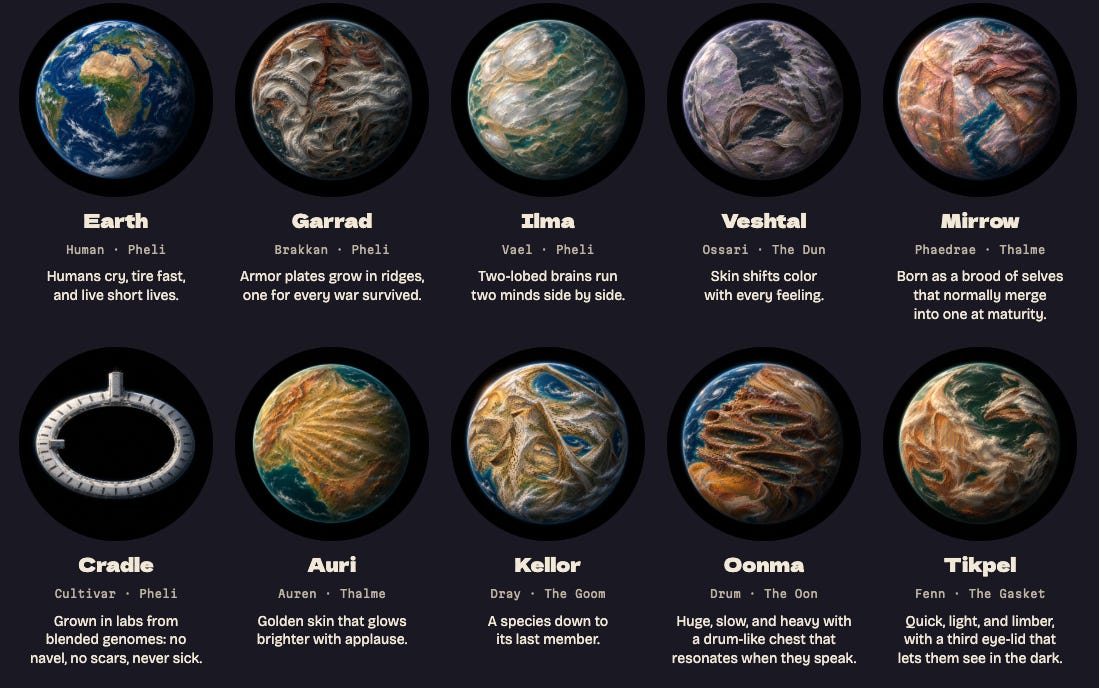
Worlds and ships get the same treatment. For a planet the fragments get wrapped onto a sphere, and when it’s painted the seams turn into coastlines and ridges and riverbeds. Which is why no planet out there looks like a copy of Earth. Except Earth.
Rules for the paint
Turns out the painting pass has habits of its own, so we wrote rules for it too. The head sets the body, so an exotic head doesn’t get human arms and five-finger hands by default. Every limb has a job, if it touches the ground it’s support and if it grabs it’s a hand. Gear gets cut for the body wearing it, and you check the silhouette small and dark. And humans stay human.
Our first crew lineup had four very different heads sitting on the same human body in the same jacket and trousers. Ugh. We ran the rules and the bodies changed. Nym got long, many-jointed hands to go with that nested head. Vesk’s four lower limbs float now, curled up off the floor. Kellen went back to a plain human head. Tukkar was already right so he stayed put.
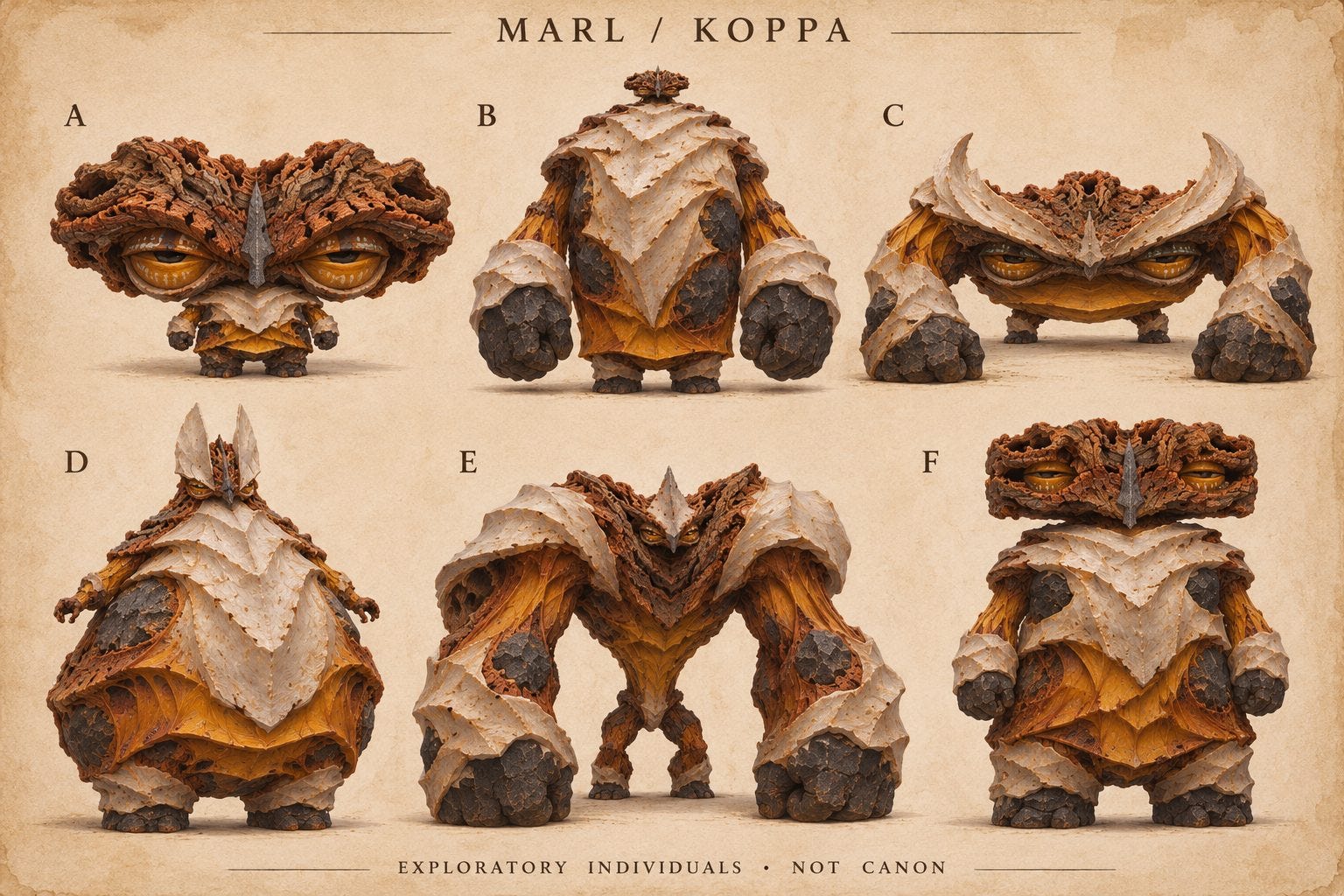
The newest part of the workbench is a Design lens.
You label the pieces of a collage head, body, limbs or details, lock the ones you love and lay out comparison sheets. From there we used earlier collages as references and had AI image generation push the proportions a lot further.
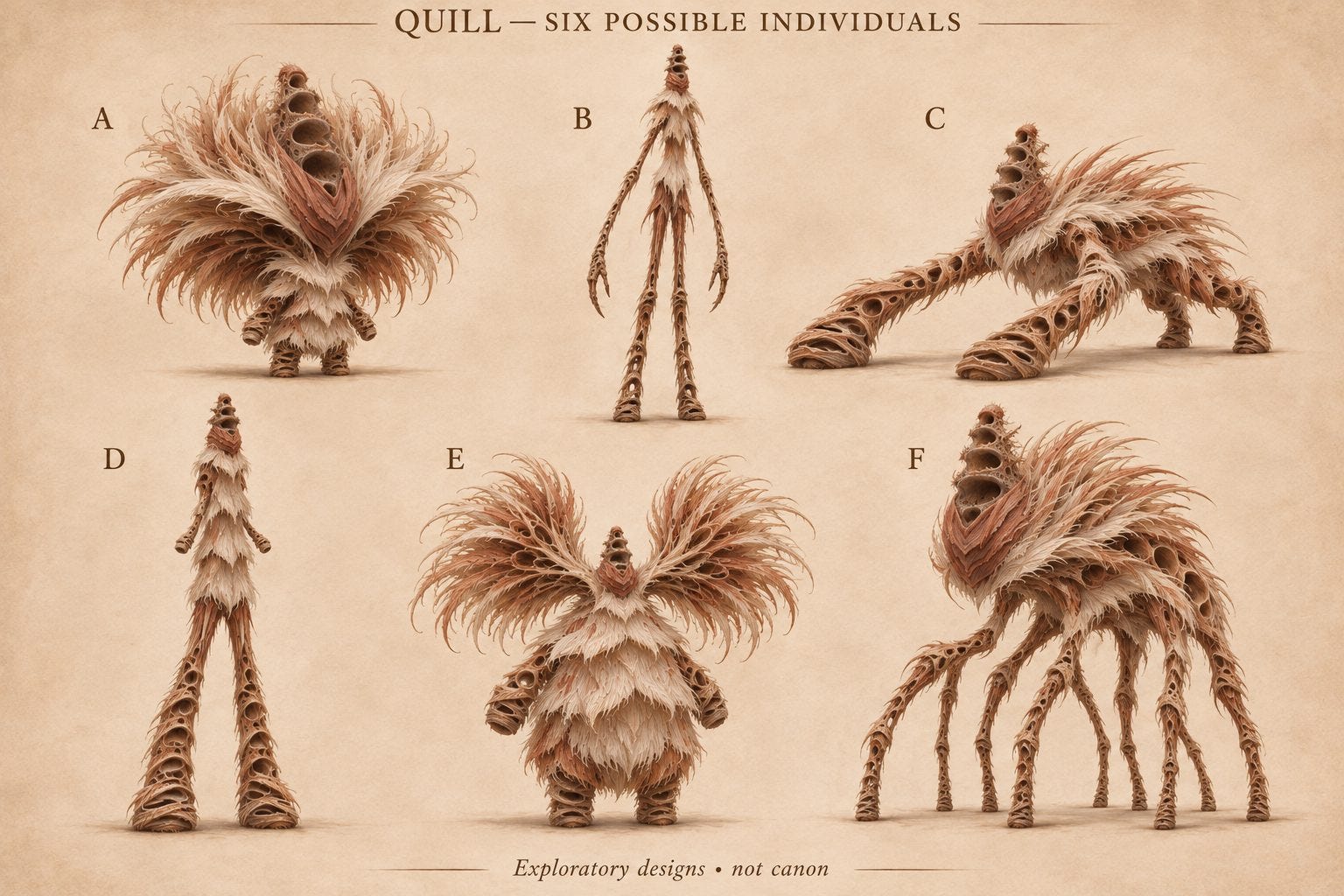
Huge heads on little bodies, towering long-limbed ones, broad ones with too many arms. Almost every people got six possible bodies, and none of it’s canon yet. The point was range first, then seeing which ones felt right for the story.
What I’d tell another scribbler
Go back through your old pitches. That spy show needed a new genre, and the new genre needed new bodies.
Write the rules before the content. Six rules are what keep ninety-nine stories from blurring together.
Don’t ask a machine for the average. “Scary alien” gets you the average alien. Give it something weird and specific to start from, a junk drawer, a seed, a mirror line, and then your taste has something to push against.
And keep your rejects. You never know which people they belong to.
Come look
It all lives at orbitalranch.studio/dark-cell. Meet the crew, flip through the board of ninety-nine warrants, fly around a 3D galaxy, read Abigail’s notebook with the names blacked out.
There’s a step-by-step walk through the art process too, rejects and all. The workbench is locked for now, but if I gave you the password, you could makebadapples