

I’ve built my share of tech villains. AI billionaires training murder drones, sentient code deciding humanity’s had its shot, the whole Skynet playbook. It’s the pitch every exec understands in one sentence, because the moment the machine turns evil, nobody in the room has to think too hard about who typed the command.
Then a story like this one lands —
— A police chief in Georgia spent more than a year running his ex-girlfriend’s license plate through a nationwide camera network. Hundreds of searches, no warrant attached, just a man chasing a woman with department credentials. When she found out, through an audit log compiled by the watchdog site Have I Been Flocked, the tool that caught him was the same paperwork trail the system generates on everyone, all the time, automatically.
That’s a Washington Post investigation, published this month, sourced from police and court records.
Skip The Robot Uprising
Every scribbler pitching an AI thriller reaches for the same button: the machine wakes up, Skynet blinks, HAL decides, the chip achieves consciousness and turns on its makers.
Real life keeps scribbling an alternate take. The machine stays asleep the whole time. The guy with the login credentials wakes it up and points it exactly where he wants.
History backs this pattern up. The printing press spread propaganda faster than any pulpit could counter it. The telephone gave con artists a direct line into living rooms. Photoshop turned a darkroom trick into a courtroom weapon.
The Camera Network
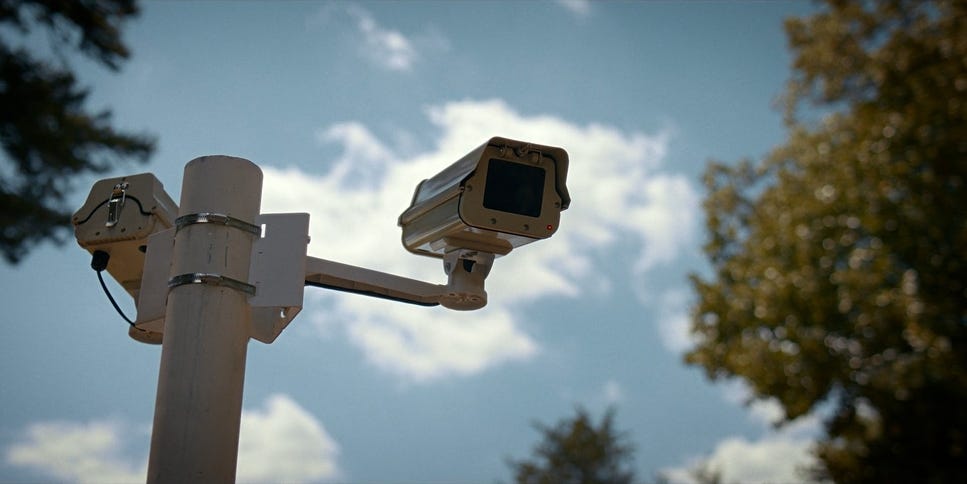
Flock Safety’s automated license plate readers now cover more than 120,000 cameras across more than 6,000 communities, scanning roughly 20 billion plates every month. The system exists to catch stolen cars and outstanding warrants.
It also turns out to be very good at answering questions nobody in a city council meeting ever approved it to answer.
The Washington Post counted at least 50 law enforcement officers charged with or accused of misusing plate reader systems for personal reasons, most of them tracking women. Forty-six of those cases ran through Flock specifically. Twenty-six involved an officer monitoring a wife, girlfriend, ex-partner, or someone else’s new partner.
Roseville, California ran its own internal numbers separately and found that 71 percent of the felony and stolen-vehicle alerts its Flock cameras generated over two years were built on a misread license plate.
Seven bad reads for every three good ones, on a system meant to justify pulling someone over.
Cities are noticing. A crowdsourced project called DeFlock now maps camera locations nationwide, and a growing list of city councils have cancelled contracts or shut cameras off entirely.
It only took someone with a login and a grudge, and a system that logs everything except intent.
The Permission Machine
New tech rarely invents a new sin. It industrializes an old one.
A location database grants permission to stalk at a scale no human could manage on foot. A synthetic voice grants permission to fabricate a conversation. A generative model grants permission to manufacture evidence a judge and jury might actually believe.
The person wielding the new tool makes that call, every single time. The tool just removes the friction that had slowed bad decisions down long enough for someone to reconsider their worst impulses.
This Has A Name Already
Intelligence analysts figured this out decades before Flock existed. During the Snowden years, the NSA’s inspector general confirmed a dozen substantiated cases of analysts running surveillance systems against people they were sleeping with, married to, or interested in.
Analysts nicknamed it LOVEINT, a play on SIGINT. Most surfaced through self-reporting, often during a routine polygraph. No safeguard flagged the search first.
Swap NSA for a police department and SIGINT for a plate reader, and the story runs on the same engine with a smaller budget.
The Cycle Never Changes
New surveillance tech shows up promising public safety. Someone proves it catches a real criminal. Somebody else, usually someone with legitimate access, realizes it also solves a personal problem.
Why This Belongs In Your Pitch Deck
Pitch decks are full of SkyNet AI stories. Real life is full of ordinary people with legitimate access and a personal reason to misuse it, and that story doesn’t require inventing new physics.
Here are four, built from the mechanism above: ordinary access, an old human want, and a tool patient enough to do the dirty work.
The divorce. An entrepreneur trains a personalized model on fifteen years of texts, emails, home videos, Ring footage, and family photos. At custody hearings, the model starts generating evidence nobody can disprove because nobody can tell it apart from the real thing.
Anatomy of a Fall (2023) — the entire case turns on whether a recording can be trusted, and the marriage collapses under the same scrutiny as the evidence.
Black Mirror, “The Entire History of You” (S1) — a couple’s relationship gets destroyed by rewatchable, replayable memory. Same core wound (intimate footage weaponized inside a relationship), older tech.
Grounding: this is already happening. Family law sites and Forbes both reported 2025 custody cases involving AI-generated audio submitted as evidence, including a fabricated threat recording built from old voice messages.
Or the reputation attack. A city council candidate discovers someone quietly feeding half-true facts into dozens of AI systems. Every search summary and chatbot bio drifts further from the truth. He ends up fighting a future version of his own life story, one that keeps rewriting itself faster than he can correct it.
Black Mirror, “Bête Noire” (S7, 2025) — A gaslighting parable for the disinformation age. A woman’s reality gets quietly rewritten by someone with a grudge and a device, and nobody else can see it happening.
Black Mirror, “Joan Is Awful” (S6, 2023) — an ordinary person’s life is algorithmically repackaged sans consent.
Grounding: A Georgia radio host sued OpenAI in 2023 after ChatGPT invented an entire fake embezzlement complaint against him. The suit got dismissed on summary judgment in 2025, so it’s not a legal precedent, but it’s proof the fear is already in the world and already in court.
Or the cop. A respected detective starts running a plate database against his daughter’s abusive ex. Everyone in his life agrees he’s right to do it. Then he runs her new boyfriend, then her roommate, then anyone she spends more than an hour with. The audience follows every decision and understands every one of them, right up until they realize the cop is now the perp.
The Conversation (1974) — still the gold standard. A surveillance expert’s own tools and expertise become the instrument of his unraveling. Swap tape reels for a plate database and the shape barely changes.
Nightcrawler (2014) — obsession with a tool escalating past every ethical line, told from inside the obsession rather than at arm’s length. Useful for keeping the audience implicated rather than horrified from a distance.
Grounding: you don’t need a comp here, you have a source. This week’s Washington Post investigation is the premise, already reported, already named, already in court records.
Or the neighborhood. An HOA installs cameras after a burglary. Crime actually drops. Six months later, every resident realizes they know exactly where every other resident goes, every night. The block gets exactly as safe as everyone hoped. It also stops being private, for anyone, permanently.
Home Invasion (2023, Fantasia) — an essay-documentary built around Ring doorbells and the paranoia they manufacture in otherwise safe communities.
Rear Window (1954) — the classic version of this problem: watching the neighbors is safety and violation at once.
Grounding: HBO’s Neighbors (2026, A24-produced) launched as HBO Max’s biggest unscripted debut, built entirely on the premise that property disputes between ordinary Americans are must-watch television right now.
The Actual Ending
Science fiction spent years warning us machines would learn to act like people. Reality keeps handing us people who already knew exactly how to act, and just needed a faster tool for unleashing their inner creep.
What’s the real-world AI misuse case you’ve already spotted that would make for a killer streaming thriller? Got one? Now —
— ABS. Always. Be. Scribbling.