

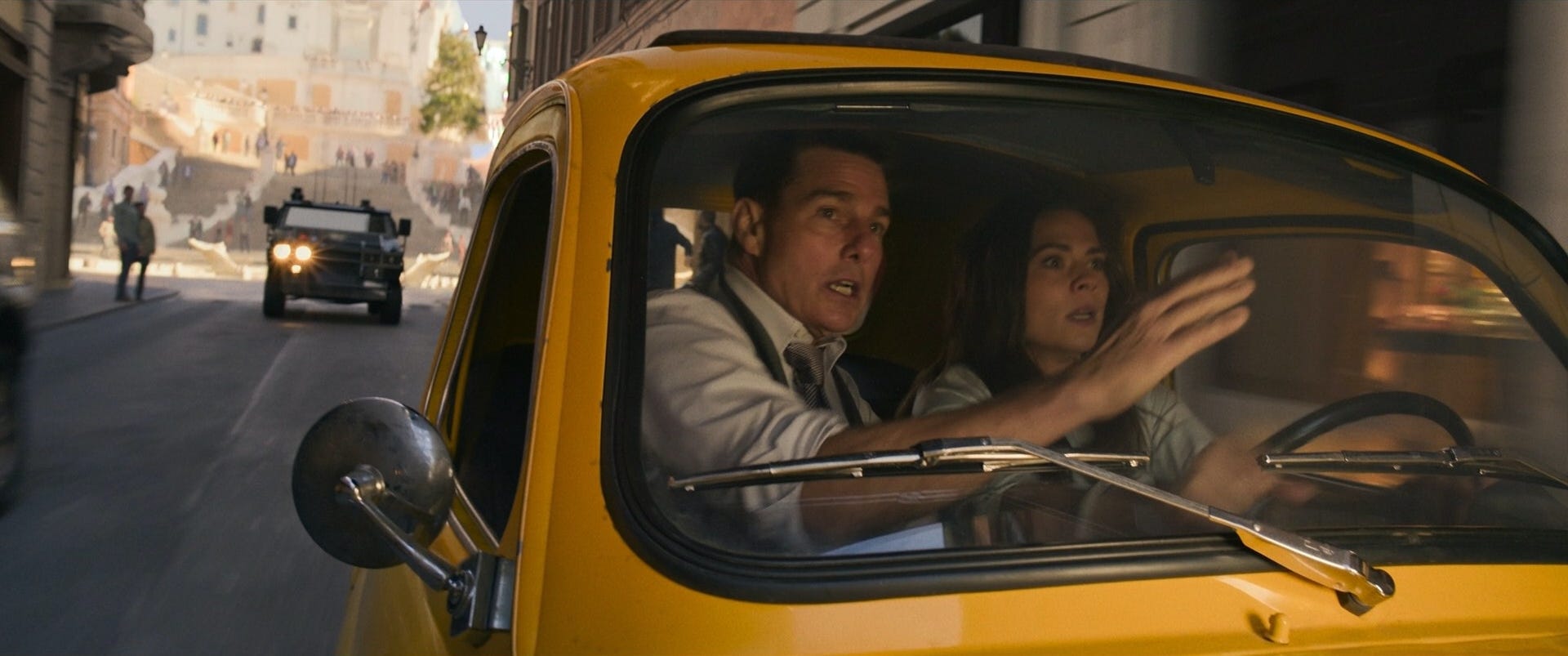
I figured this out sideways. I was deep in designing tactical systems for a tabletop role-playing game. Pressure. Options. Consequences. I kept noticing how the machinery under a good tactical encounter worked. Then I looked back at the action scenes I’d scribbled over the years and recognized the same engine.
The Action Engine
Scribblers chase moments. Big visual hits. The spectacular image. That gives you fragments, not scenes.
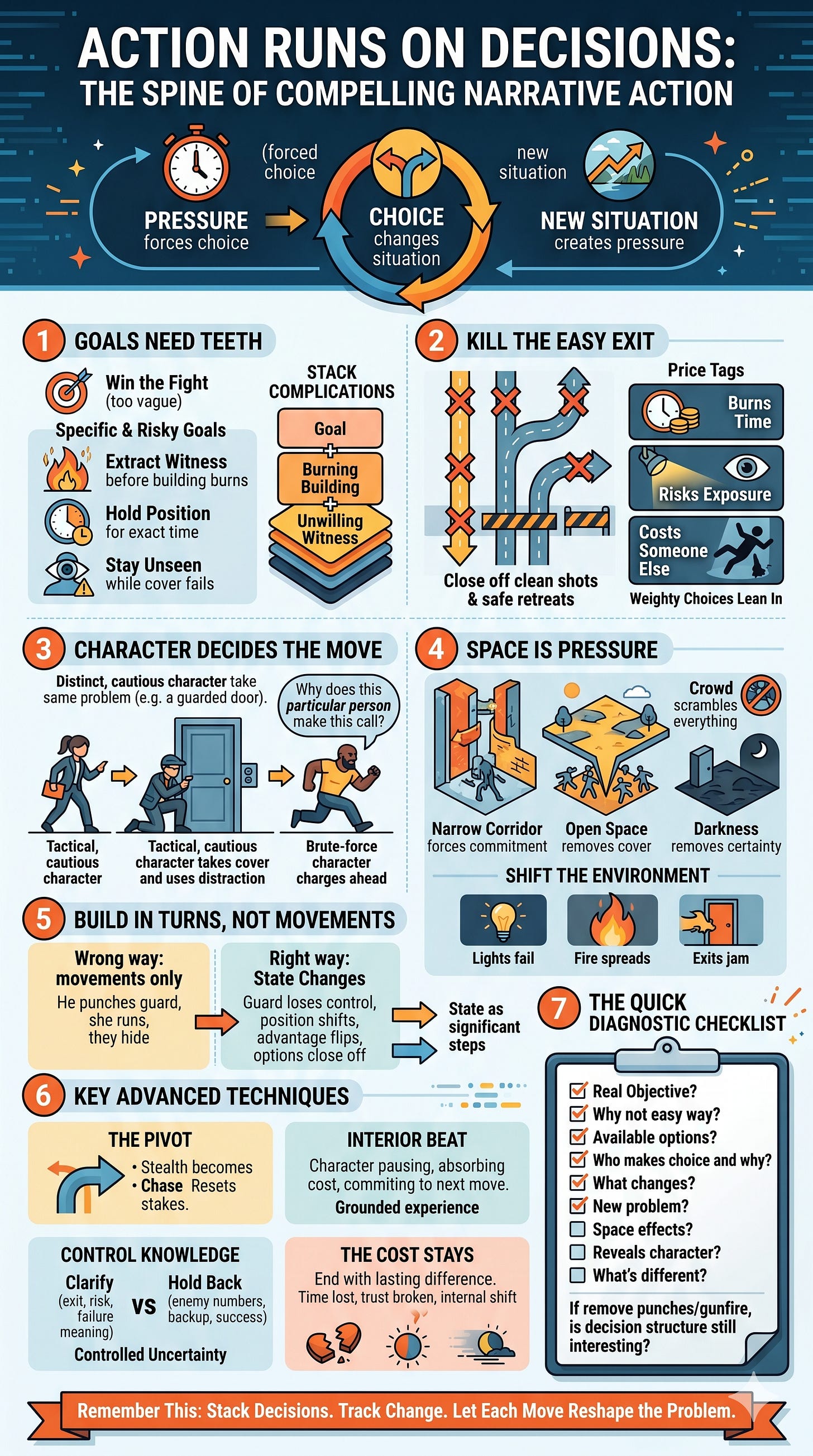
The engine is simpler and harder to fake. Pressure forces a choice. The choice changes the situation. The change creates new pressure. That’s it. That loop is the spine of every action scene worth watching. Run it clean and the scene carries itself. Lose it, and no amount of gunfire will save you.
Goals Need Teeth
“Win the fight” is not a goal. It’s a placeholder.
You want a goal that can fail in interesting ways. Get the witness out before the building burns. Hold the position for exactly two minutes. Stay unseen while your cover is about to be blown. Capture the target without pulling the trigger.
Then stack a complication on top. Protect someone who doesn’t want protecting. Preserve the cover story while using skills that would blow it. Refuse to cross a line your character has never crossed.
Now the goal pulls in two directions at once. That tension drives behavior. The behavior builds the scene.
Kill the Easy Exit
If the direct solution works, there’s no scene.
So close it off. No clean shot. No safe retreat. No clear exit that doesn’t cost something. Now your character has to think, choose, and commit.
The shape underneath every good action beat is: problem, solution, new problem. He can’t cross open ground without getting shot. He flips a table and advances behind it. Now he’s pinned when it stops moving. She can’t beat a larger opponent in strength. She attacks the knee. Now he’s down and close enough to grab her. Each solution creates the next problem. That chain is the spine of your scene.
Create options that carry a price. One burns time. One risks exposure. One costs another character. When options hurt, choice carries weight and the audience leans in.
Character Decides the Move
Put two different people facing the same problem. You should get two different scenes.
One leans forward. One reads the room. One protects and one cuts loose. The question underneath every action beat is: why does this particular person make this particular call?
Answer that, and the scene stops being a stunt reel. It becomes a character scene with cool explosions.
Space Is Pressure
Location isn’t decoration. It’s an active force.
A narrow corridor forces commitment. Open space removes cover. A crowd scrambles everything. Darkness removes clarity. Locations should apply pressure before your character takes a single step.
Then you shift it. Lights fail. Fire spreads. Exits jam. The environment turns against the plan. Now the problem is evolving while the character is still solving it. That’s a cool scene.
Build in Turns, Not Movements
Listing actions doesn’t create momentum. Tracking change does.
Each beat needs to alter something real. Position shifts. Advantage flips. Options close. If the situation is steady from one action to the next, it stalls no matter how big the bang bang.
It goes like this. Beat one: pinned behind cover, no clean angle. Choice: move into the open. Cost: exposure spikes. Gain: new angle acquired, new problem created. The situation after the beat isn’t the situation before it. That change is the scene.
A practical tool: when you outline, list beats as state changes, not movements. Not “he punches the guard.” Instead: “guard loses control of the doorway.” Not “she runs to the door.” Instead: “the exit becomes unusable.” The verbs show up when you draft. But this forces the structure underneath to be narrative first.
Hard Pivot
A strong action scene doesn’t just escalate. It becomes something else halfway through.
A stealth approach becomes a chase. Escape becomes a rescue. Survival turns into sacrifice. Pivots reset the stakes without stopping the momentum. The audience thought they knew what kind of scene they were watching. They were wrong. Now they’re locked in.
You Need An Interior Beat
Action needs an interior beat. Not a pause, not a speech. A beat.
Something goes wrong. The character absorbs it. Understanding the cost. Then commit to the next move. That rhythm keeps the scene grounded in experience rather than motion. Without it you get a pure spectacle that is easily forgotten. Experience stays with you.
Control What the Audience Knows
Clarity carries tension. Track the essentials: where the exit is, what’s at risk, what failure means. The audience needs those three things. Beyond that, hold back. Keep enemy numbers unclear. Backup uncertain. Real doubt for your characters about pulling this off.
That balance keeps a scene legible and tense at the same time. Confusion isn’t suspense. But controlled uncertainty totally is.
Real Consequences
When your scene ends, something should be different.
Time lost. Trust broken. Position compromised. Something shifted internally that can’t be unshifted. An action scene that leaves the story exactly where it began isn’t driving your narrative.
State it simply: at the end of this scene, something that was true is no longer true. That change is what drives the story forward. The chop-sockey, gunfire, and boom-boom is the delivery mechanism.
Quick Diagnostic
When you need a fast read on whether a scene is working, run your beats through this rubric:
What’s the real objective? Why can’t it be done the easy way? What options are available? Which one gets chosen, and why this character? What changes as a result? What new problem appears? How does the space affect the decisions? What does this reveal about who this person is? What’s different when it ends?
One more, and it’s the hardest one: if you removed all the punches and gunfire, would the decision structure still be interesting?
If the answer is yes, your scene has a real spine. If not, you know where to go back in.
My Scribbler’s Takeaway
Action scenes don’t run on spectacle. They run on decisions under pressure.
Stack the decisions. Track the change. Let each move reshape the problem. Do that and the scene builds its own momentum.
The explosions take care of themselves.
Some Examples:
Goals Need Teeth: Top Gun: Maverick (2022)
The Scene: The final mission (The “Miracle Run”).
The Goal: It’s not just “blow up the plant.” It’s “hit a three-meter target at high speed, pull 9Gs to escape a mountain wall, and do it all in under two minutes and fifteen seconds.”
The Teeth: If they fly too high, they’re erased by SAMs. If they fly too slow, they miss the window. If they don’t hit the G-strain perfectly, they crash into a coffin of rock.
The Takeaway: The “teeth” here are the literal physical constraints of the jet and the terrain. Every second on the clock is a decision: Do I push the engine and risk a flameout, or do I stay safe and fail the mission?
Space is Pressure: John Wick: Chapter 4 (2023)
The Scene: The Arc de Triomphe traffic circle.
The Location: It isn’t just a backdrop; it’s a meat grinder of moving steel.
The Pressure: Wick isn’t just fighting assassins; he’s navigating high-speed traffic that doesn’t stop for a gunfight. The space dictates the moves—cars become mobile cover, then weapons, then obstacles that split the fight in two.
The Takeaway: The environment forces Wick to constantly recalculate. He can’t just stand and shoot; he has to time his reloads between gaps in traffic. The space is a character trying to kill him.
Character Decides the Move: Everything Everywhere All At Once (2022)
The Scene: The Fanny Pack Fight.
The Decision: Waymond (Alpha-Waymond) needs to take out a room of security guards without “killing” his way through them, using only a fanny pack.
The Logic: This isn’t a generic hero punch-out. Waymond’s movements are fluid, resourceful, and slightly absurd, reflecting the “verse-jumping” logic. He uses the fanny pack to extend his reach because he is a character who optimizes mundane tools.
The Takeaway: If you put Batman in that room, it’s a 30-second beatdown. Because it’s Waymond, it’s a chaotic, rhythmic dance. The who dictates the how.
The Pivot: Mission: Impossible – Dead Reckoning Part One (2023)
The Scene: The falling train carriages.
The Setup: It starts as a classic fight on the roof of a moving train (The “Escape” beat).
The Pivot: The bridge is blown. Suddenly, the goal isn’t “beat the bad guy”; it’s “climb through a vertical train that is currently falling into a ravine.”
The Takeaway: The stakes reset instantly. The horizontal chase becomes a vertical escape. The audience’s understanding of “safety” is yanked away, forcing the characters to make entirely new types of decisions (Do I grab the heavy gold bars for the mission, or let them go so I can jump to the next car?).
Kill the Easy Exit: The Batman (2022)
The Scene: The hallway fight in the finale.
The Problem: Batman needs to reach a group of gunmen in a pitch-black hallway.
The Easy Exit: A “generic” action hero might have a flashbang or a high-tech gadget to disable them from afar.
The Constraint: He has neither. He has to walk down the hall, taking hits in the dark, using only the strobing light of gunfire to see.
The Cost: He takes massive physical damage to close the distance. Every step is a choice to endure pain for the sake of the objective.
Cool graphic!!