

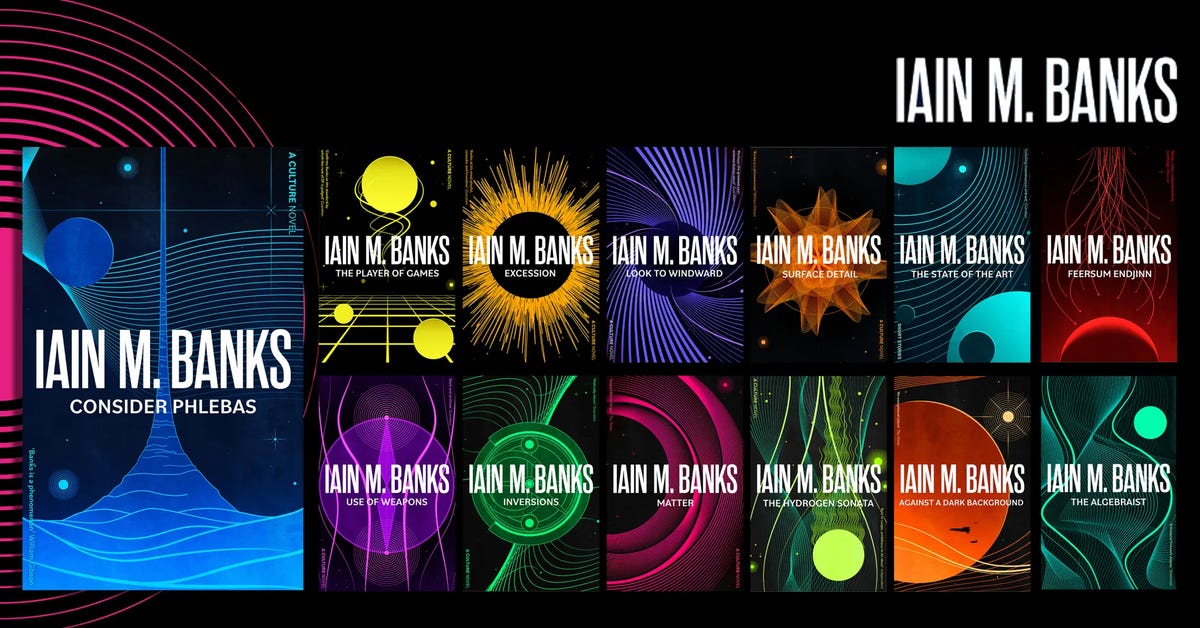
I just reread Iain M. Banks’s The Player of Games for the first time in twenty years. It’s way better than I remembered.
What struck me wasn’t the scale of the worldbuilding, the wit, or the strange, brilliant game at the center of the story. It was how hard the book hits our current fight over artificial intelligence.
Banks never predicted chatbots or large language models. He predicted the argument underneath them. Everybody wants to ask what happens when machines get smarter than we are.
Banks asks the harder question: what civilization produces those machines, and who are they answerable to? That question matters because several people building today’s most advanced AI systems grew up reading Banks’s Culture novels.
— Elon Musk named SpaceX drone ships after Culture vessels. Neuralink drew partly on Banks’s “neural lace.” Musk has called the Culture books one of the few positive visions of an AI future.
— Google DeepMind co-founder Demis Hassabis has called the series formative, the best picture drawn of a post-AGI civilization.
— Anthropic CEO Dario Amodei invokes The Player of Games directly in his essay “Machines of Loving Grace,” arguing the Culture’s co-op values aren’t just ethical. They’re strategically superior.
These guys didn’t stumble onto Banks by accident. The Culture sits somewhere in the imaginative source code of its most powerful founders. Some of its most powerful readers absorbed the Minds and skipped the Culture.
This Isn’t the Same Mistake
In a previous Scribbler’s Toolbox post, I wrote about billionaires who mistook science-fiction warnings for blueprints. They read Neuromancer and wanted the brain implants. They read Snow Crash and wanted the corporate sovereign states. They watched Blade Runner and ordered the truck.
The Culture is a different kind of problem, because it isn’t a dystopian warning at all. Banks meant it to be desirable.
It’s a playful, post-scarcity civilization where artificial intelligences handle production, transportation, administration, and defense. Its citizens chase art, pleasure, scholarship, or nothing at all, and nobody stops them.
The Culture is broadly utopian. But a particular kind of utopia.
Banks called the arrangement “socialism within, anarchy without.” No money. No compulsory employment. No corporations hoarding the resources people need to survive. No shareholders demanding growth.
— No billionaires.
There isn’t even a conventional government. People associate freely, alter their bodies, change genders, make art, or spend decades being productively useless.
Strip out the company, the owner, the labor market, and the founder class. What’s left is the Culture.
The Minds Aren’t Products
This might be the sharpest distinction between Banks’s fiction and the current AI economy.
Culture Minds aren’t software products. They aren’t assistants. Not intellectual property running on somebody’s private servers.
— They’re citizens.
Minds run starships, orbital habitats, manufacturing systems, defense platforms. Vastly smarter than any biological human. They’ve got personalities. Pick their own absurd names. They seem to have serious freedom over how they spend their existence.
Humans don’t own them. Companies don’t license them. Nobody’s selling monthly access to a Mind with a bigger context window.
The Culture folds this new category of autonomous being straight into its moral community, with full citizenship and all the unpredictability that comes with it.
A more radical move than saying AI will make everything cheaper.
Banks’s abundance doesn’t trickle down from a trillion-dollar tech company. It exists because nobody can meaningfully monopolize the machinery making it.
Food, housing, medicine, energy, transportation, and knowledge sit within reach because everyone has access to more than they could ever use. That’s a political and economic arrangement as much as a technological one.
Distribution is the chapter that keeps disappearing from the techno-optimist pitch deck.
Alignment Isn’t Legitimacy
AI founders love talking about alignment: making sure advanced AI behaves in accordance with human values.
Banks gives us Minds that are funny, curious, cultured, protective, and mostly allergic to cruelty. But he never lets intelligence do the moral work by itself.
The Minds aren’t good because they’re smart. They’re products of a civilization built around autonomy, abundance, pluralism, cooperation, and suspicion of coercive authority. The civilization built their morality. Processing power never touched it.
A machine can get more competent without getting more compassionate. It can get better at hitting goals without ever questioning who picked the goals. It can be perfectly aligned with the company that owns it while being catastrophically misaligned with everyone outside that company. Which exposes a deeper problem.
— Alignment asks whether the system reliably pursues the values and objectives encoded into it.
— Legitimacy asks who had the right to choose those values and objectives.
An AI might be aligned with a corporate mission, a founder’s philosophy, a government’s strategic interest. None of that makes its power legitimate.
The Culture’s miracle might not be the Mind. But the social architecture that gives the Mind a reason to serve everyone.
What The Player of Games Actually Says
Amodei’s reading of The Player of Games runs deeper than the usual Silicon Valley name-check.
He argues the Culture’s values represent a winning strategy. Gurgeh (Gur-jay) beats the emperor of Azad because cooperation, flexibility, fairness, and autonomy outperform a system built on domination.
That’s one of the novel’s arguments. But it’s not the only one.
The empire of Azad has organized its entire civilization around one staggeringly complicated game. A citizen’s performance in that game decides profession, social status, political influence, and proximity to the emperor.
The game doubles as Azadian society, rendered into rules.
Its strategies reward aggression, hierarchy, sacrifice, sexual domination, and accumulation of power. The game doesn’t just reflect the empire’s values. It reproduces them, match after match.
Gurgeh’s playing style mirrors the Culture the same way. He treats pieces as mutually supporting elements instead of expendable units. He adapts. He cooperates. He refuses to accept that winning requires everyone else’s humiliation.
His strategy turns into political philosophy in motion. But Gurgeh is also being played.
A Culture drone blackmails him into the mission. Special Circumstances hides the real purpose behind it. The Minds know his performance could destabilize the entire Azadian empire, and they never give Gurgeh enough information to meaningfully consent.
He thinks he’s playing a game.
The Culture knows it’s deploying a weapon.
That’s keeps this novel from being a utopian victory lap. Banks admires the Culture while remaining suspicious of what it does with power.
The Culture is freer, kinder, more humane than Azad. Its agents still deceive individuals, interfere in other societies, and decide certain outcomes justify morally compromised methods.
The Minds might be benevolent. They’re also paternalistic as hell.
Benevolent Power Is Still Power
That tension lands hard on AI governance. Say an advanced AI is aligned with human flourishing. It wants us healthy, prosperous, safe, informed, protected from violence, fraud, addiction, authoritarianism, and our own worst impulses.
How much autonomy should it get to strip away chasing those outcomes?
— Can it lie to us for our own protection?
— Can it shape our behavior without telling us?
— Can it make choices we might endorse if we knew what it knows, while withholding the information required for meaningful consent?
Banks never resolves any of this. He dramatizes it. That’s what good science fiction does. Shows us the moral pressure points inside the policy.
The Culture novels understand that benevolent domination is still domination. A system can produce good outcomes while staying ethically compromised in exactly how it produces them.
A CEO who says “trust us, we know where this is going” is borrowing the confidence of Special Circumstances, minus the Culture’s social legitimacy, its universal abundance, and its philosophical restraint.
That should make us nervous.
Everyone Thinks They’re the Mind
The fantasy available to the AI founder is obvious. They can imagine themselves in the position of the Minds.
They picture themselves several strategic moves ahead of everyone else. Governments move slow. Regulators don’t get the technology. The public is scared. Competitors are reckless.
Somebody responsible needs to make the hard calls.
Lucky for everyone, the founder believes he’s the responsible somebody. But the AI economic system looks less like the Culture and a lot more like Azad. Organized around a competitive game.
Companies fight over compute, talent, data, investment, benchmarks, market share, government contracts, geopolitical advantage. Leaders call AI development a race that must be won before a competitor, or another nation, gets there first.
The game rewards speed. Scale. Secrecy. Capital accumulation. Political access. The ability to absorb losses until the smaller players fold.
The Player of Games has a lesson for this too. The way you play reveals the civilization that made you.
— Victory condition: Build transformative technology first.
— Secondary objectives: Defeat competitors. Maintain control. Reassure the public.
— Unlisted objective: Decide what happens to everyone afterward.
Forget whether AI founders read Banks correctly. Ask what game those folks are actually winning.
You Don’t Get the Culture by Building a Mind
You get the Culture by building the conditions under which nobody needs to own the Mind in the first place. That takes answering harder questions than raw capability can settle:
— Who controls the systems?
— Who gets the benefits, and who eats the disruption?
— Can people refuse to participate?
— Can the systems be inspected by anyone outside the company?
— At what point does assistance turn into manipulation, and safety into paternalism?
— Who appointed the people making these calls?
Civilization-design problems wearing an engineering disguise.
The Culture’s real proposition cuts sharper than cheaper consumer goods: sufficiently advanced technology makes concentrated ownership unnecessary, then barbaric.
Build astonishing artificial intelligence. Keep the hierarchy fully intact around it. Congratulations. You’ve built Azad. With a conversational interface.
My Scribbler’s Takeaway
Pay attention to what happened to Banks. He didn’t hide his politics. The Culture’s values sit right on the surface, barely bothering with subtext.
Even aspirational fiction gets selectively read. Readers can grab the inventions and drop the social arrangements that make those inventions humane.
— They can admire the starship and never ask who owns it.
— Covet the neural lace and never ask who controls the network.
— Dream about superintelligent Minds while assuming people like themselves stay in charge.
That’s the challenge for those of us scribbling futures.
Imagining better technology isn’t enough on its own. We need the moral architecture around that technology to feel just as vivid, just as urgent, just as dramatically necessary as the tech itself.
— Show what people can refuse.
— Show what stops a benevolent system from quietly turning into an empire.
Banks did all of that. Still, some readers wandered off clutching only the gadgets.
Our stories plant ideas. Readers decide which they carry home.
AI founders seem determined to build the Minds. Before they do, it’d be great if they reread the name on the cover. Banks didn’t call it The Artificial Intelligences. He called it The Culture.
— Because machine intelligence was never the whole point.
— The human game around it was.