

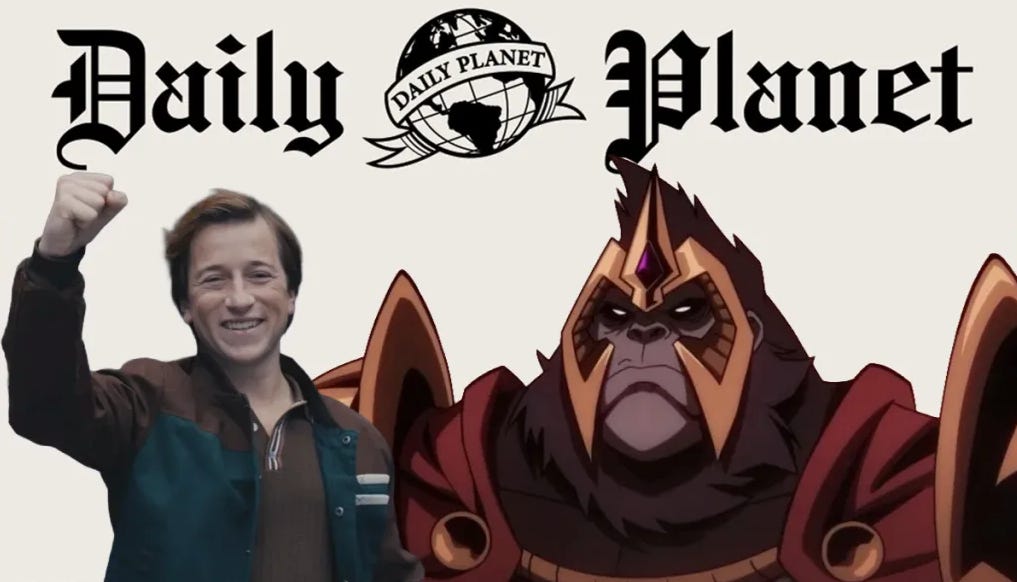
A superintelligent ape stands convicted of killing his father, the King of Gorilla City. A Daily Planet reporter reopens the case. Eight episodes, true crime grammar, in mockumentary format.
That’s The People v. Gorilla Grodd, ordered straight to series at HBO Max from Tony Yacenda and Dan Perrault, the American Vandal team, with Yacenda directing every episode and James Gunn and Peter Safran producing. Skyler Gisondo plays Jimmy Olsen. Jimmy Tatro plays Grodd. Wendell Pierce plays Perry White, with Beck Bennett as Steve Lombard and Mikaela Hoover as Cat Grant.
Y & P stated their goal in the announcement: it should feel “less like an entry into the DCU and more like an artifact from it.”
On paper, it’s a great pitch. I’m sure it’ll be fun and look forward to watching. But I’m a man of a certain age. A DC fan from my days wearing footie pajamas. But I can’t help wondering —
— Why are we disassembling DC icons before this generation has seen them assembled?
Deconstruction Is a Second Draft
Frank Miller published The Dark Knight Returns in 1986. It landed like a bomb because readers had spent forty-seven years with another Batman. Alan Moore had the same advantage with Watchmen. Both books spent a debt the culture had already paid, and the payment was decades of earnest, unironic, cape-and-cowl belief.
Marvel ran the identical math. Guardians of the Galaxy arrived in 2014, six years and nine pictures after audiences watched Steve Rogers throw himself on a grenade and mean it. Gunn got to make the joke because somebody else had already made the promise.
Subversion is a response to something already established.
Irony Fatigue
People keep blaming superhero fatigue for the softening box office. The diagnosis is off by one word. Audiences still want the heroes. It’s the winking that’s wearing them out.
When every project elbows the audience in the ribs, dissects its own tropes, and runs world-saving heroics through a mockumentary filter, the message reaching the not-cheap seats is that the people making this stuff find the material a little embarrassing.
Marvel spent years on forced meta humor and taught a generation that sincerity is the setup and the joke is the payoff.
All that irony is cheap armor. Nobody can call your hero corny if you called him corny first.
Gunn Already Built the Straight Man
Gunn’s Superman was sincere. Big blue boy scout, cape, dog, hope. It made $618.7 million worldwide. Gunn and Safran said the Grodd series exists because of “Skyler’s wonderful performance and the fantastic chemistry of the Daily Planet cast,” which is a straight line from earnestness to spinoff.
So they did lead with the myth. Then they immediately started turning into the dark alley behind it.
Second Swing is a Miss
Supergirl opened June 26, 2026, on a budget reported between $170 and $186 million. Craig Gillespie directed, Milly Alcock starred, and the pitch was a road movie in outer space with a darker tone than Superman. Gillespie named True Grit, Logan and John Wick as his touchstones, a Venn diagram with no cape in the overlap.
It opened to $38 million domestic, $68 million worldwide, and finished at $125.8 million worldwide. Superman earned that entire run in its opening weekend. Critics landed at 54 percent on Rotten Tomatoes across 303 reviews. Audiences gave it a B minus CinemaScore, and a B minus on a superhero picture is the sound of a room walking out unsure what it just watched.
Alcock got good notices. I thought she was terrific. Her performance kept turning up in the positive reviews. The footing beneath her feet is what moved away from the exact thing that had worked-ish eleven months earlier.
The Grodd series appears to be making the same error in a different key. Superman played it straight and an audience showed up. But Gunn’s Superman wasn’t an origin story. There was no space for young DC newcomers who might want super PJ’s or figures.
The second entry went grim, the third goes mockumentary, and neither one is the sincere version of anything. Two swings away from the register that barely got ‘em across the finish line, and DC’s second foundational figure still hasn’t been introduced.
One Hero Is Not a Pantheon
I don’t think I’m alone over my skies when I submit that DC has only three foundational figures. Superman. Batman. Wonderwoman.
Let’s look at where the other two sit right now. Paradise Lost, the Themyscira series that was supposed to carry Wonder Woman into this universe, is no longer in development at DC Studios.
The Brave and the Bold has no date, and Gunn has said why: “I’m dependent on when there’s an actionable script ready so there is no way of me guessing this. Also, frankly, we’re well into Batman 2, and I wouldn’t want to cloud the Batsphere until after that.”
One of three has been introduced. The other two are a shelved series and a script that isn’t finished. The up in the air WB/Paramount merger can’t be making the dev process any easier.
Start filing edges off a mythology in that condition and the satire arrives before the audience has anything to measure it against. Grodd’s a punchline in a world the audience visited once.
In Defense of Gunn’s Troma Trigger
Give Gunn his due. He treats a comic universe as an ecosystem, a place where bizarre people actually live, pay rent, and get on each other’s nerves. That’s the Troma gene, the Gen-X indie gene, and it produced Guardians, Suicide Squad, Peacemaker and Creature Commandos, which are genuinely compelling and authentically his.
World-first, hero-second is a legitimate strategy. It builds texture fast. It makes a universe feel inhabited.
It also depends on the audience already caring who these heroes are. Texture is the second layer. You can’t start with weathering.
Who Is DC For?
Two audiences.
There’s the ten-year-old who wants awe. There’s the thirty-five-year-old who listens to true crime podcasts and loved Spinal Tap.
There’s room for both, only one can be served first, because the ten-year-old is where the next thirty-five-year-old comes from.
I miss Adam West and Burt Ward playing it absolutely straight in the middle of pure lunacy. I miss Lynda Carter’s Diana Prince, who never once apologized for the tiara. I miss Donner’s Superman, which believed in its own goodness hard enough to make an entire planet believe with it. The Lego Batman Movie works, and that’s a feature-length joke, because the foundation of the myth underneath was strong enough to carry the weight.
I’m only just realizing I forgot to mention Lanterns which is what initially put me in this headspace. Can you guess? It disassembles the myth of a character only Geoff Johns and a few others grok.
Your Order of Operations
Rules for any scribbler walking into an established mythology.
Build the sincere version first, and let that sincerity ride all the way down. No hedge, no wink, no character standing offstage rolling their eyes at the premise. Let earnestness be the wall the rest of it hangs on. Young audiences can forgive a corny hero. But will they attach to one who’s embarrassed to be there?
Wait until the audience loves it without your help. The clock on deconstruction starts when the straight version becomes common property, when people quote it, CosPlay it, and fanboys cannonize it. Miller waited forty-seven years. Marvel waited six.
You can aim the knife at the myth. Watchmen takes heroism seriously enough to break it in public. But satire that mostly signals how cool the creators are can turn the audience into the mark, and an audience that feels like the mark won’t be amused.
Deconstruction is one of the sharpest tools in a scribblers toolbox. One that requires something already be well built.
DC put up one standing set and drew a crowd (ish). Now they’re scribbling a mockuseries about the goofy and grimy adjacent alley.
Maybe before we explore the funny and weird corners of Metropolis, we stand out in the light for a minute and believe a man can fly.
I’m looking forward to seeing newly divorced BatMite, Mister Mxysptik, and Bizzaro working on their Tinder profiles while poolside at The Sportsmen’s Lodge.