

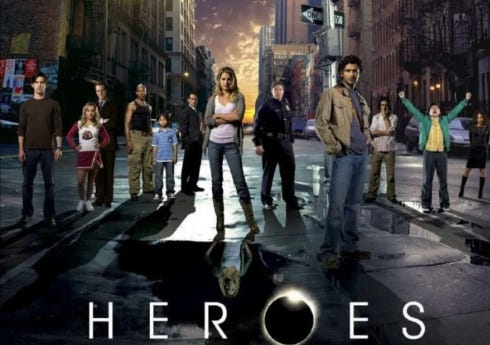
The first season of Heroes still has one of the cleanest structural engines in modern genre television.
Not the cleanest mythology or finale. Not the cleanest explanation of how powers work. What Season 1 has, and the series later loses with almost surgical precision, is a simple organizing principle: every strange thing is being pulled toward the same terrible event.
At first glance, Heroes looks like an ensemble superhero origin story: ordinary people discover extraordinary abilities, conspiracies stir in the background, a killer moves through the margins, destiny mutters through comic-book panels and prophetic paintings. That was the hook. But the deeper pleasure of the season is not “people have powers.”
The deeper pleasure is convergence.
Season 1 begins with scattered lives: a cheerleader in Texas, a hospice nurse in New York, a salaryman in Tokyo, a cop in Los Angeles, a politician with secrets, an artist painting the future, a father whose horn-rimmed glasses conceal a moral universe.
For much of the season, these characters don’t know they’re in the same story. The audience does. Or rather, the audience suspects. That suspicion is the engine.
Everything bends toward the same event: the explosion in New York.
That future disaster gives the season shape. It makes every subplot feel like a tributary. Hiro’s journey isn’t just whimsical time-travel adventure. Claire’s invulnerability isn’t just teenage metaphor. Isaac’s paintings aren’t just occult production design. Peter’s empathic power isn’t just a protagonist upgrade.
All are pieces of a single dramatic machine.
“Save the cheerleader, save the world” works because it’s both ridiculous and perfect. It’s specific, mythic, and finite. It takes the impossible size of “save the world” and pins it to one vulnerable human being. That’s structure doing poetry’s job.
The later seasons keep the vocabulary of Season 1: powers, prophecy, secret organizations, catastrophic futures, shifting alliances, comic-book chapter titles. But they gradually dismantle the architecture that made those elements feel inevitable.
Convergence gives way to escalation.
After Season 1, the show repeatedly substitutes a larger premise for a clearer one. Season 2 has the Shanti virus. Season 3 has the formula, Pinehearst, synthetic abilities, and another battle over the future of evolved humans.
Again and again, the series reaches for a new global threat, a new prophetic crisis, a new faction behind the previous faction.
The problem isn’t that these ideas are inherently bad. Any one of them might have supported a focused season. The problem is they don’t create the same gravitational pull.
Season 1 asks, “How do these people become the only people who can stop this one terrible thing?” Later arcs more often ask, “What is the next terrible thing?” That question can generate episodes, but it doesn’t automatically generate momentum.
Metaphor gives way to inventory.
In Season 1, the abilities feel like character made visible. Claire heals, but her gift isolates her from normal adolescence and turns her body into evidence. Peter absorbs other people’s powers because his defining trait is empathy. Hiro bends time because he’s innocent enough to believe destiny should be answered with joy. Matt hears thoughts, which only sharpens his insecurity and domestic failure. Niki’s fractured self isn’t just a power set; it’s a horror story about survival, shame, and repression.
Later, too often, powers become modular. They can be stolen, copied, suppressed, restored, injected, traded, or upgraded. Arthur Petrelli can strip Peter of his abilities. The formula can manufacture powers. Mohinder can experiment on himself. Claire’s blood can restore Noah after death.
Each turn creates plot, but the more transferable the powers become, the less they feel like intimate burdens. They stop seeming like fate and start seeming like store bought equipment.
Sylar is the perfect bridge between those two versions of the show. His original function is horrifying because he turns the metaphor into appetite. If powers are the thing that make people special, Sylar is the man who decides specialness can be harvested.
That’s a great idea. It’s also an idea with a shelf life.
In Season 1, he’s frightening because the story uses him sparingly and directionally: aftermath, rumor, bodies, hunger. Once he remains onstage season after season, the show has to keep finding new ways to complicate, soften, redirect, redeem, and re-monster the guy.
Zachary Quinto is strong enough to make much of it watchable, but structurally the character becomes a problem the show just can’t solve because it refuses to spend him.
Partial knowledge gives way to explanation.
Noah Bennet is compelling early on because we can’t immediately classify him. He is a loving father. He’s also terrifying. The Company is frightening because it feels vast, old, and morally opaque. We understand just enough to know its reach is enormous and its ethics are compromised. But we don’t know enough to reduce it to an org chart.
But TV has a habit of feeding on its own mysteries. The more Heroes explains its institutions, histories, bloodlines, founding sins, and internal power struggles, the smaller the world becomes.
Explanation isn’t always revelation. Sometimes it’s drainage.
This may be the deepest structural wound. Season 1 has stakes because the future feels heavy. Death feels possible. Discovery feels dangerous. Identity feels unstable in ways that cannot be casually reset.
Later, the series becomes increasingly good at dismantling itself.
Peter’s memory can be erased. Powers can vanish and return. Futures can be averted and replaced. Noah can die and be revived. Nathan can die and still be narratively prolonged through Sylar, shapeshifting, and Matt’s psychic intervention.
A story can survive almost anything except the audience learning that consequences don’t stick.
There is, of course, production history here. The 2007-2008 writers’ strike cut into Season 2, and TV gets made under pressures that criticism can flatten too easily.
But the pattern outlives any one disruption. The show’s problem wasn’t simply that one season was interrupted. It was that the series kept reaching for supersized scale after it had lost shape.
The cruel part is Season 1’s finale isn’t flawless. In some ways, it’s less satisfying than the build. But the season survives its own imperfect landing because the architecture has been so strong.
We remember the feeling of being drawn toward something. The pleasure of separate lives clicking into place. The thrill of a genre show behaving, for a while, like a novel with a spine.
The problem with Heroes wasn’t that it ran out of ideas. It had ideas everywhere. Too many, probably. The problem was that it lost the discipline that made those ideas matter.
The first season remains great because it understands that destiny is most powerful when it narrows. The whole world is at stake, yes. But the story works because the world depends on a cheerleader, a dreamer, a nurse, a painter, a father, a brother, a killer, and a city none of them can yet see clearly.
For one season, Heroes knew exactly where everyone was going. Then it mistook having more road for having a map.