

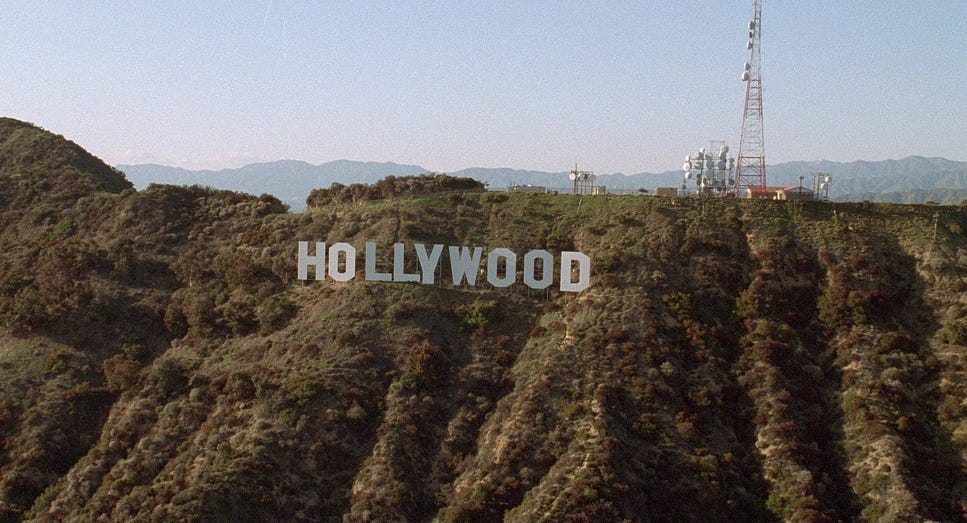
“Hollywood is freaking out.” That phrase, from a podcast, a news segment, a family conversation, makes my eye twitch. The word gets used like it refers to a single creature with one brain and one agenda.
It never has been that. So why do we keep talking like it is?
The Word You’re Looking For Is Metonymy
“Hollywood,” “Washington,” “Wall Street,” “Silicon Valley.” These are place-names standing in for whole messy systems. The move has a name: metonymy. A related thing (the place) stands in for the larger concept (the industry, the government, the money machine). “Hollywood” as shorthand for the American film and TV business is a textbook case.
Metonymy is quick. Fits a headline. Slides into a hot take. It also lies by omission.
Your Brain Likes Simple Targets
There’s a psychology piece underneath the language. When we look at a group we’re not part of, we tend to perceive its members as more alike than they actually are. Social psychologists call it the outgroup homogeneity effect. Plain English: “They’re all the same. We’re complicated.”
That bias doesn’t require malice. It doesn’t require ignorance. The brain compresses. Compression is where nuance goes to die.
“Hollywood” Is Not a Monolith. It’s a Crowd Scene.
Set the psychology aside and the industry itself fights the single-entity label. Film and TV run on networks: freelancers, short-term crews, shifting teams, unions, vendors, agencies, studios, streamers, financiers, lawyers, managers, publicists, post houses, and a thousand quiet jobs nobody tweets about. Researchers who study the business describe careers shaped by social networks and project-based labor markets, not one centrally controlled machine.
The geography has dissolved too. Production moves. Tax incentives move it. The “Hollywood” part isn’t one place anymore.
So when someone says “Hollywood wants X,” the real translation is usually: a subset of powerful players, inside a shifting ecosystem, are pushing for something that other powerful players are resisting, while a lot of working scribblers and crew are trying to keep the lights on.
Less catchy. More true.
Why Podcasts and Headlines Love the Monolith
“Hollywood” is a clean villain. Or a clean hero. Or a clean punchline. It gives you a single target for blame, credit, anger, fear, envy. It turns a complicated set of incentives into a simple story with one character.
Great for a segment. Bad for your understanding.
Extra strange in entertainment coverage, because the business runs on disagreement. Studios compete with studios. Streamers compete with streamers. Agencies compete with agencies. Creatives fight creatives. Labor fights management. Management fights other management. Everybody fights the calendar.
“Hollywood” is not one opinion. It’s a negotiation.
A Better Way to Say It
Swap the metonym for the actual lever:
“The legacy studios are pushing for...”
“The streamers are reacting to...”
“The agencies are betting on...”
“The financiers are tightening...”
“A lot of working scribblers are worried about...”
And if the conversation is about people moving into a town and changing it, that’s migration plus money plus culture. The place-name just makes it easier to point the finger.
Scribbler’s Takeaway
Next time you hear “Hollywood is...” add one question in your head: Which part?
That question cracks the monolith. Turns a lazy label into a real conversation. Makes room for truth, which is always messier, more human, and usually more interesting than the cartoon version.