

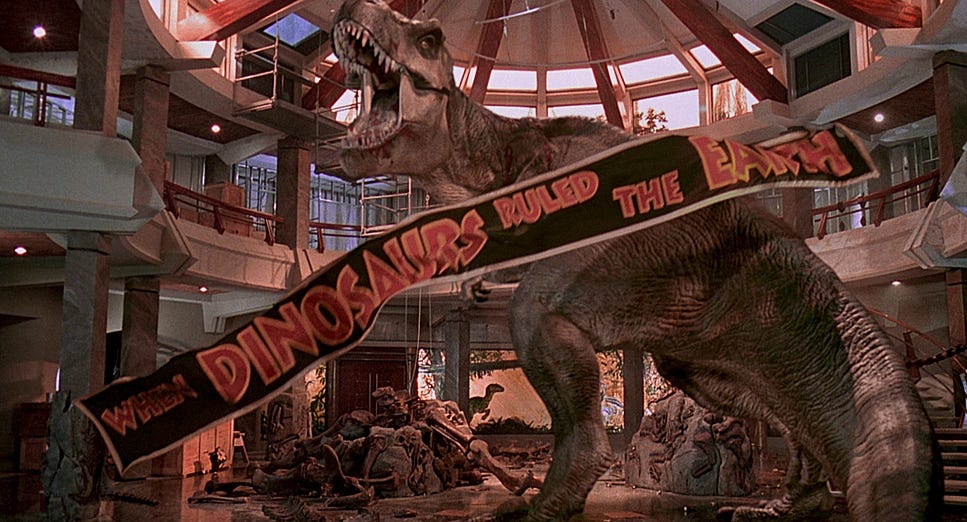
Phil Tippett got called extinct by his own movie in 1993, then spent the rest of the shoot proving it wrong. A three-time Oscar winner just ran the identical play on Dune: Part Two, thirty-one years later. It’s a clear read on how this business survives contact with a render farm.
“It looks like we’re out of a job.” “Don’t you mean extinct?”
That’s Alan Grant and Ian Malcolm in Jurassic Park, and the second line wasn’t invented for a laugh.
Phil Tippett said almost exactly that for real, standing in a screening room in 1993, watching Industrial Light & Magic’s first photoreal CG dinosaur test: “I think I’m extinct.” Tippett was the film’s credited Dinosaur Supervisor, one of the best stop-motion and go-motion animators alive, hired to build every dinosaur in that movie one frame at a time, by hand. Spielberg showed him what the computer artists had built instead, and Tippett’s own reaction ended up written into the finished film almost word for word.
I grew up on the man Tippett learned from. Ray Harryhausen, skeleton warriors clashing on a beach in Jason and the Argonauts, animated one frame at a time on a rig in his garage, wired straight into whatever part of my brain later decided telling stories for a living was a reasonable plan.
Watching a render farm generate in a weekend what Tippett’s career had been built on should have ended him right there in that screening room.
It didn’t.
Spielberg kept him on the film and put him in charge of the one thing the computer artists still couldn’t do: making the dinosaurs move and behave like animals instead of monsters. Weight. Gait. The way a predator actually watches a jeep instead of just menacing it for the camera.
The physical animating passed to other hands. Tippett kept the eye, the part that knew what a believable predator looks like. That eye turned out to be the whole job, and Tippett spent the rest of the shoot teaching a T-Rex how to hunt.
The Squeeze Has a Number Now
I’ve felt a version of that same squeeze the last two years, minus the render farm. Gigs that would have landed easily two years ago went to a smaller room, sometimes no room at all, and the free time that opened up did something I didn’t see coming.
I started building. Random games. Worlds. Assets, stories, merch, whatever a given afternoon wanted to become. Somewhere in that pile I started suspecting my own ikigai is sitting inside a transmedia world I build myself, which meant actually learning what these generative tools do, past the demo reel.
The GDC crowd already knows the number: 63% of game design and narrative professionals hold an unfavorable view of generative AI, second-highest of any discipline in the business behind visual and technical art, ahead of programming.
GDC’s 2026 State of the Game Industry report ran that stat next to a few others that explain the mood: a third of US game industry professionals laid off in the last two years, two out of three people at AAA studios watching their own company do the cutting, 74% of students entering the field worried there won’t be a job waiting when they finish the degree.
Fifty-two percent of the industry now calls generative AI’s impact negative, up from thirty percent the year before and eighteen the year before that.
Wrong Link
Type a sentence into Sora, Veo, Runway, or Kling and thirty seconds later you’re holding a moving image that didn’t exist an hour ago. That’s the public argument: prompt in, movie out, actors and crew and continuity all optional. Great demo reel.
It has almost nothing to do with how a real pipeline gets built in 2026.
The actual chain runs seven links: script, design, performance, generative asset creation, compositing, editorial, conventional finishing.
Generative tools own exactly one of those. Sora and Veo and Runway and Kling, the same names that just generated a full scene from one sentence, do real work at that link too, but they get pointed at a single plate, a single extension, a single background element the production already storyboarded.
The script, the production design, the performance an actor delivers on a stage or in a mocap volume: people in a room, making choices, author every bit of it.
Compositing, editorial, the finish a studio signs off on: all of it still runs through the same craft it always has.
The Blue Eyes, Thirty-One Years Later
Paul Lambert ran Tippett’s exact play on Dune: Part Two, just with better tools and three Oscars already on his shelf, one of them for the first Dune.
The flaw he needed to fix was a color: the right shade of blue in every Fremen’s eyes across Arrakis. His team hand-rotoscoped 260 shots from the first film into a training set of 30,000 pairs of eyes, built a machine learning model out of it, then pointed the model at more than a thousand new shots of Zendaya’s Chani and every other Fremen in the sequel.
It didn’t just work and walk away, either. Eye size and shape change shot to shot, so plenty of frames still needed a compositor’s hand, roto’d the old way by the artists at WylieCo, then fed back into the model to make the next pass smarter.
Nobody generated Chani’s performance. Nobody generated the blocking, the sandworm chase around her, or a single choice Zendaya made in that scene.
Lambert built one tool, aimed it at a single correctable, deeply boring detail, and kept everything else exactly where it already was: in the hands of the same artists who’d have painted those eyes by hand a decade earlier.
AI Production Design
Name the skill and it stops sounding mysterious: AI production design. Same two words the art department has used for a century.
Knowing which pieces of an authored scene can get generated without losing character, performance, or continuity. Knowing, just as precisely, which pieces never leave a human’s hands.
Tippett protected the walk. Lambert protected the eyes. A screen-scribbler protects the scene itself, on the page, before a director, a compositor, or a generative tool ever gets a turn.
Write a character’s choices sharp enough on the page and everyone downstream knows what can’t be touched without the scene stopping being that character’s scene. That’s the job opening up in this business right now, and almost nobody’s training for it.
The Sixty-Second Test
Most people testing this stuff try one shot. That only proves a tool can generate a pretty picture. It proves nothing about a workflow’s ability to hold a production together, because a single shot has no character to keep consistent, no location to match across a cut, no prop that has to be the same prop twice.
Build sixty to ninety seconds instead. One recurring character. One location. Props that show up more than once. Cuts that must hold editorial continuity the way an actual scene does. Run a workflow through that, and every weak seam will show up.
Forget whether the tool can make one shot look expensive. Ask if the character still looks like the character, the room still looks like the room, the cut still lands like a cut, sixty seconds in.
New Tools, Old Instincts
Tippett didn’t stop working after that screening room in 1993. Lambert’s name is still in Dune’s credits thirty-one years later for the identical reason: he knew exactly which detail belonged to the machine, and which one never left his artists’ hands.
I think about that split constantly now, building worlds out of whatever a given afternoon hands me, deciding by gut which piece I generate and which piece I sit down and actually scribble myself, frame by frame, like Tippett with that T-Rex.
Learn that same read on your own scene, and the credit still has your name on it.