

Runway’s terms of use warn, in capital letters, that outputs may not be unique and similar outputs may be generated for other users.
Luma assigns you the rights to your shot on the condition that you generated it while holding a paid plan permitting commercial use.
Generate on the free tier and the watermark stays welded to that asset forever, whatever you upgrade to later.
Higgsfield rewrote its own terms inside of three days in July, after a thread breaking them down cleared 331,000 views on X. Everybody who signed up before that rewrite has been bound by the new version since August 7.
Three video companies, one summer, and not one of those sentences has anything to do with how the footage looks.
I Haven’t Generated a Frame Yet
Straight up front, so nobody mistakes this for a review. Everything below is my own research, done while I work out which of these tools I’m actually going to pay for in time and money.
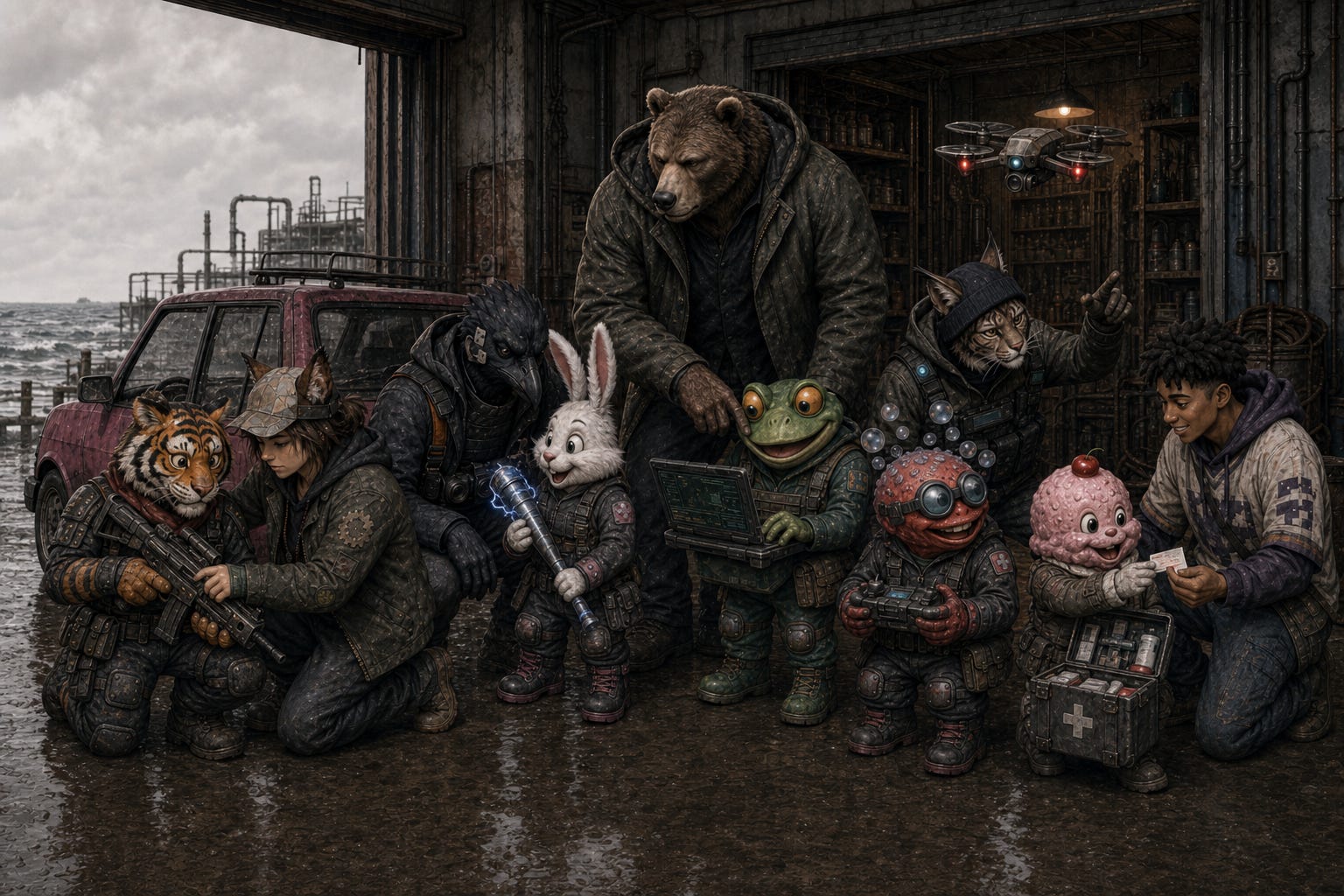
The reason I’m doing the research is a project called Warranty Void. Five operators running freelance work through Lost Angeles in 2066, inside the Terra Conflictus world I’ve been building. The whole thing is scribbled to exist as found footage. In-world video posted by the crew themselves, operator logs, recovered files, fixed cameras nobody was supposed to be looking at.
That format comes with a technical demand welded into it. The same five faces have to come back artifact after artifact. The same streets. The same gear on the same shoulders. Recurring characters in a recurring city collapse the second shot two looks like a different person than shot one, and that failure mode is the one every honest review of these tools keeps circling.
I’ve scribbled about this stuff already. Phil Tippett walking into Jurassic Park as Dinosaur Supervisor and walking out having taught a T-Rex how to hunt. Paul Lambert taking 280 hand-rotoscoped Fremen shots out of the first Dune, cropping and augmenting them into a training set of 30,000 eyes, then pointing that model at a thousand more shots in the sequel.
I made the case that the job opening up right now is AI production design, knowing exactly which portion of an authored scene can be generated and which portion never leaves a human’s hands.
Making that case and running the pipeline are different jobs. Warranty Void needs sixty seconds of moving picture standing on its own before anybody’s going to care about page one.
So this is a scribbler at the starting line, having my AI minions read contracts and comparison charts, trying to figure out what a stack is supposed to look like before diving in.
Nobody Buys a Camera Package
Two decades of production teaches you one useful reflex here. You build a department. Every piece of gear on that truck earns its slot by doing one job nobody else on the truck can do.
The AI video market keeps getting covered like a horse race. Which model wins. Which one just leapfrogged the other. That framing sells clicks and tells a working scribbler almost nothing, because these tools are not interchangeable and the differences that decide a project sit in camera control, character consistency, editability, and license terms.
Three roles, already visible in how people actually work.
The board room. Image-led previs. Lookbooks, character explorations, scene boards, the visual bible that keeps every downstream shot pointed the same direction. Firefly and an Adobe-adjacent image workflow fit here.
The primary workspace. One place where you iterate on hero shots, keep your references, version your variants, and assemble something. Runway carries the strongest reputation for this because it operates as a production-facing environment with reference-driven character consistency built to hold a face across a whole sequence.
The specialists. A second and third engine you point at the shots your primary tool handles worst. Luma when a shot lives or dies on believable motion through real space. Kling when a strong source still is driving the image. Higgsfield when the whole idea of the shot is a camera move.
Thirty-Five Millimeter Handheld, Push Through the Arcade
Higgsfield is one I keep circling, and the reason is vocabulary.
Its Cinema Studio ships north of seventy named camera presets. Dolly in, crane up, 360 orbit, crash zoom, Dutch angle, Snorricam, FPV drone. You pick the move off a menu the way you’d call it on a set, and the platform routes the job to whichever engine it thinks fits, Kling or Sora 2 or Veo 3.1 or Seedance.
Reviewers keep landing on the same two-part read: best-in-class directorial camera control, and a credit system that empties faster than anybody plans for, with premium models running forty to seventy credits a clip and credits expiring in ninety days.
Here’s what that means for anybody who came up on a set or in a scribblers’ room. You already have the language. Thirty-five millimeter handheld, push through a crowded arcade, sharp rack focus to the protagonist. That sentence is legible to a controllable camera system in a way it never was to a plain prompt box. Coverage, lenses, blocking, screen direction, motivation. Every one of those is a control surface now.
The unfair advantage a screen scribbler brings into this market is knowing what to ask the camera for.
Three Questions the Demo Reel Won’t Answer
Every platform’s marketing page runs similar sizzle. The terms of service is where the differences live, and it comes down to three questions worth asking before you upload anything you care about.
Who owns the output. All three of these say they don’t claim ownership of your inputs or your outputs. Luma goes further and assigns you its own right, title and interest in the output. Fine as far as it goes, and it doesn’t go as far as it sounds.
Can you sell it. Generally yes on a paid plan. Luma ties commercial use directly to the subscription that was active on the day the asset was generated, and those rights vest permanently in that specific asset. Free and Lite generate watermarked, personal-use-only material, permanently, and hand Luma a much broader license back on top of it.
Can somebody else make the same thing. No platform will promise you otherwise. Runway says so in its own all-caps: outputs may not be unique and similar outputs may be generated for other users.
Then the one that should stop a working professional cold. None of those answers touch clearance. Platform terms cannot hand you rights in a recognizable actor’s face, a logo in the corner of your frame, a needle drop, a copyrighted character, or a reference image you pulled off somebody’s portfolio.
Ownership of output and clearance of what’s inside it are separate problems, and only one of them shows up in the terms of service.
Perpetual Is Already in Everybody’s Terms
The word that torched Higgsfield in July was perpetual. Go read Runway’s terms of use. Section four grants Runway a license over any inputs and outputs generated through the service, described as non-exclusive, irrevocable, perpetual, worldwide, royalty-free, fully paid, transferable and sublicensable.
That’s the same string of adjectives, in the same order, sitting in the terms of the tool with the best reputation in this market.
Luma’s grant runs a shorter list aimed at a narrower target. Worldwide, non-exclusive, irrevocable, perpetual, royalty-free, sublicensable through multiple tiers, covering the processing, hosting and storage of output produced during an active subscription, for the purpose of improving the service and training the models. Every tier below Enterprise is inside that.
Nobody made a thread about either one. Higgsfield got dragged because a company sent a terms-update email at the exact moment enough people were paying attention to read it. The clause itself is standard practice across this entire category.
You are not choosing between a company that takes a license and companies that don't. All three take one. You are choosing how wide it runs, how long it survives you, and whether anybody happened to be reading the day it changed.
Three Days in July
Higgsfield ran the lesson in public, on a clock anybody can check.
The July 23 update handed the company a license over user inputs and outputs described as perpetual, irrevocable, transferable and sublicensable, covering uploaded faces used for character generation.
A thread from Theoretically Media breaking it down went wide and cleared 331,000 views. By July 26 a revised version was up with the perpetual and irrevocable language deleted, rights now ending when a user deletes their content or account, and promotional use limited to material a user made public or consented to. New users were bound immediately. Existing users were bound as of August 7.
The training grant survived the rewrite word for word. Content still trains the models by default, the only consumer opt-out is deletion, and enterprise gets carved out. Model weights that already learned from your material don’t unlearn it.
Four provisions got quietly tightened in the company’s favor on the way through, including a fifteen-day notice guarantee downgraded to reasonable notice.
The contract you agreed to in the spring is not the contract you’re working under in August.
Terms move, sometimes in three days, sometimes in your favor because a few thousand people made noise, sometimes the other direction while everybody’s watching the demo reels.
Check the effective date on the page you’re actually bound by.
The Boring Folder That Gets Your Movie Distributed
Chain of title is the unglamorous folder that decides whether anybody can distribute your picture.
Same discipline applies here, and building it from day one costs nothing. Log the exact terms version in force when you generated, the plan tier and the receipt, generation dates and prompts, licenses for every uploaded source, raw outputs sitting alongside the human edit files, script drafts, boards, sound licenses, and a shot log naming your creative choices on every single shot.
That packet is worth more than any claim about which model made what, because human authorship is the part you can actually prove.
A scribbler who can produce a documented trail from script draft to boards to shot log to final cut is holding something. A scribbler who can only say the AI made it is holding a file.
Sixty Seconds, Six Shots, Every Engine
I’ve argued before that a single shot is the wrong unit for testing this stuff. One shot proves a tool can make a pretty picture. It has no character to keep consistent, no location to match across a cut, no prop that has to be the same prop twice.
So the plan is sixty to ninety seconds, run through identical inputs on every engine I’m considering.
One locked character reference, because a crew of five has to survive the cut.
Then six shots: interior dialogue setup, full-body walk and turn, an establishing shot, a complex camera move, an action transition, and a repeat of the first shot after everything else is done.
Then score the boring stuff. Continuity across cuts, usable duration, artifact rate, cost per keeper. And whether I can reproduce the same look two weeks later when the model has quietly updated underneath me.
Reproducibility separates a production tool from a slot machine.