

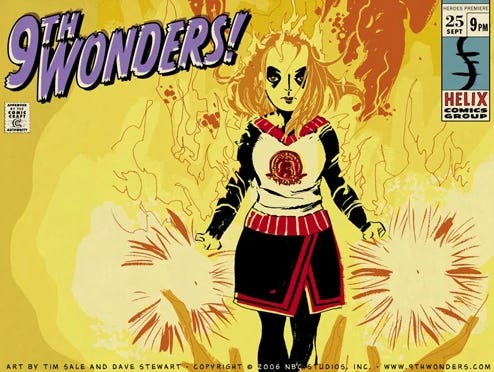
The George Washington webcomic had laser hands. Four panels, sitting right there on NBC’s Heroes site, and not one word of it had come out of our scribblers’ room.
That was the winter the WGA strike had us off the lot and on the picket line, November of oh-seven into the following February, while NBC licensing kept the machine running without us. We came back to a corner of our own universe we’d never signed off on. Historical figures with powers nobody in the room invented. Plot threads snagging on our own mythology.
We did the only thing you can do with a mess like that on deadline. Pretended it never happened.
The job is managing an ecosystem, and every ecosystem loses track of its own canon eventually. Entertainment just does it in public, in front of the people who notice first.
Toy Soldiers
A presentation crossed my desk recently, notes from a talk on scribbling fiction for a mass-combat miniatures wargame. Little plastic and metal armies. Rulebooks. Painted regiments shot for a hobby magazine. About as far from a network drama as this business gets, on the surface.
Underneath, this outfit solved the George Washington problem on purpose instead of by accident, and built the toy-box lesson into an actual system, one worth stealing if you’re scribbling for somebody else’s IP.
Toy Box and Sandbox
Any scribbler walking into somebody else’s IP should know which one they’re standing in before they scribble a word.
The toy box holds what’s too important to change. Major players, core canon. Whatever happens to them in your story, they go back in the box exactly how they came out, ready for the next scribbler’s turn. Spock stays Spock. A Riot character’s kit and personality survive your side story intact. Will Graham’s arc has to land somewhere Thomas Harris already wrote.
The sandbox is everything else, self-contained stories, minor characters, elements free to break, bend, or bury, as long as none of it leaks into the box next door. I’ve been running that split since I was about twelve. I refereed a home D&D campaign where the module’s named NPCs stayed exactly where the module left them, and everything in the empty hexes on the map was mine to wreck.
A company selling toy soldiers by the thousands landed on the identical rule from the opposite direction, backed by sales numbers instead of a twelve-year-old’s gut instinct.
Ask which box you’re in before you ask anything else. Most new hires don’t think to ask until they’ve already broken something.
You’ve Seen These Boxes Before
I grew up on Star Wars, the original trilogy, so I notice this split every time Lucasfilm makes a move. The Skywalker Saga is the toy box. Whatever era a spinoff visits, it doesn’t get to contradict what happens across those nine films.
Then look at Visions, the anime anthology where a dozen different studios get to blow up the mythology any way they want because none of it counts as canon. Or look at the High Republic, an entire new sandbox built centuries earlier so scribblers can invent factions and burn down a status quo without anybody worrying it’ll wreck the main timeline.
DC runs the same move under a different label. DC protects its main continuity, the one where Batman and Superman actually live, and quietly resets it whenever a change goes too far. Elseworlds is the release valve, a standing invitation to take the same characters somewhere the main line never could. Superman lands in the Soviet Union instead of Kansas in Red Son. Batman hunts Jack the Ripper through gaslit Gotham in Gotham by Gaslight.
Nobody needs to argue about canon. The label already told you it doesn’t count on this one, so the story’s free to go all the way.
Same architecture as my kid’s D&D table and a company selling toy soldiers by the thousands.
“You fought in the Clone Wars?”
Good worldbuilding plants flags it doesn’t dig up right away. A regiment mentioned once and never shown. A species named in a sentence and gone. A world referenced but never visited. None of it fleshed out, all of it sitting there for whoever needs a thread to pull next season, next expansion, next film. Ob Wan Kenobi casually mentioning the “Clone Wars” set the table for this one.
Lore the audience won’t cash in for years still pays off later. It’s the layer that rewards the fan on a third rewatch, a tenth match, a hundredth mission. A world worth returning to keeps giving you more to notice.
VALORANT runs this on a clock: seasonal content pulls old characters back into focus on a schedule players learn to expect and look forward to.
Never Say Never
Absolute language is a trap dressed up as authority. Always. Never. Every. Lock a rule down that hard in the text and you’ve told every future scribbler, licensee, and fan artist exactly where the fence sits. Fences get climbed. Leave the wiggle room.
Fans don’t just watch a universe, they move into it. Boxing them out of that ownership with an absolute you didn’t need costs nothing today and everything in three years.
I learned the other side of that lesson on Alias, Lost and Heroes, the expensive way. We built a mythology that ran on ambiguity, powers with soft edges, rules the audience filled in themselves.
It worked right up until network executives wanted harder answers on screen, more certainty, fewer open questions. Narrowing what used to be possible loses something that doesn’t come back.
Tokusatsu heroes never break character on screen for a reason. The moment the mask comes off, the myth stops being a myth.
Every Piece Must Pull Together
Fiction is one leg of the table. For a tabletop property, the format also stands on rules, artwork, and photography, painted regiments shot and printed so a fan building their own army knows what they’re aiming for. Pull one leg and the table doesn’t just wobble, it stops selling.
A screen franchise runs the same math on a different scaffolding: story, casting, marketing, and whatever tie-in product justified greenlighting the thing in the first place.
On Heroes, for about two years, every division actually pulled in the same direction on purpose, digital, marketing, and licensing all working the same universe at once, because the network president ordered it. Unprecedented, and it worked, right up until the show stopped being a hit worth protecting. Then everybody retreated to their own corner, and nobody ordered them back out.
Say the Quiet Part About Your Format
Every format has a wall somewhere. A mass-combat game built around identical miniatures runs into a real, structural problem building an inclusive or varied cast when every soldier on the table comes out of the same mold. That’s a fact about the format.
The honest move is naming the wall and designing around it instead of hoping nobody notices. Every medium carries some version of this. You’d better know yours before a fan finds it for you.
Find the Person Who Remembers
Scribbling the rules and the story are not the same, and treating them as one job produces bad versions of both. A studio smart about this keeps dedicated editors and translators between the raw rules draft and the page a customer actually reads, because clarity is its own craft.
The equivalent on a long-running screen franchise is the continuity mind. We had several on Star Trek: Discovery, folks who knew Vulcan mind melds require skin contact — only to be contradicted by a canon busting leadership that wanted a message carried across the galaxy. Oof.
A legacy franchise has a legit cost of entry for anyone new. The wiki is right there for anybody to read. What the wiki can’t carry is what almost got approved and got killed for a reason nobody codified. Get access to the person who remembers.
On Heroes, that person was whoever in the room recalled the meeting where somebody at NBC casually signed off on a founding father with laser hands.
The Fans Have a Spreadsheet
Pretending it never happened worked for about a week. Long-term, it’s a debt that collects interest. Every unresolved contradiction sits in the lore waiting for the one fan with a spreadsheet to find it.
Remember - You don’t own the toy box. Know which parts are locked before you touch them. Leave hooks nobody has to explain yet. Say never as rarely as you can get away with.
Whether the job is a mission briefing for a squad of identical space knights or a teleplay for a starship that was flying before you were born, the rule holds steady.
Play well in somebody else’s sandbox, and next time they might give you a shot at creating your own.