

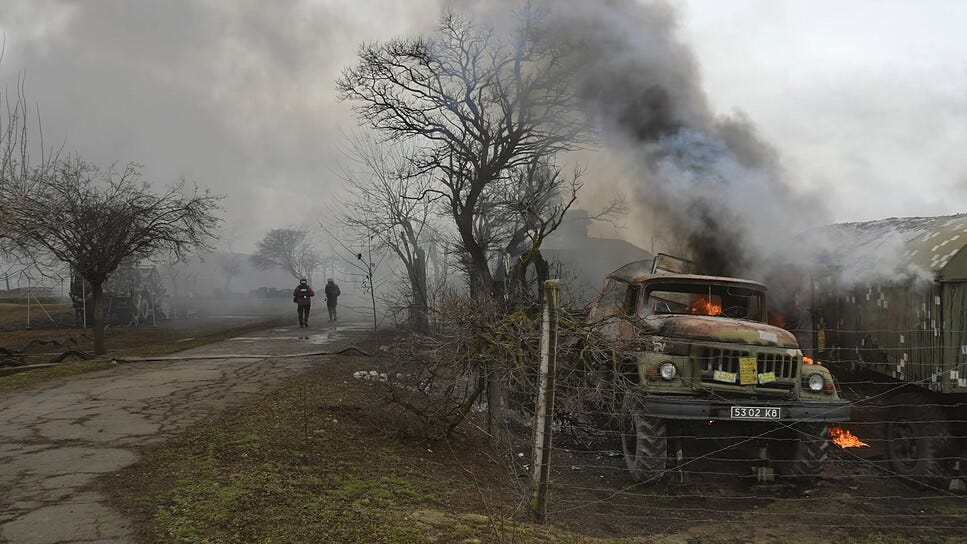
I was watching a YouTube vlog the other night from a combat veteran who’s fought in Iraq, Syria, and now Ukraine.
The infantry movement drills that kept him alive in earlier wars would get him killed almost immediately in Ukraine.
Not because he forgot how to fight. Because the battlefield changed.
What struck me wasn’t just the military insight. It was how familiar it felt. As he talked, I kept thinking, this is exactly what’s happening to scribblers and filmmakers right now.
Different tools. Different terrain. Same mistake people keep making.
Old Models Assume Fog
In Iraq and Syria, small units survived by staying unseen. You moved carefully. You used cover and timing. You trusted your eyes and instincts. Detection was human, intermittent, and imperfect.
That’ss how most of us were trained to think about filmmaking.
If you were good enough at the craft, if your script sang, if your directing chops were sharp, you could move through the system. You might get notes. Hit resistance. But talent created room.
That model assumed time. It assumed fog.
Those assumptions are gone.
Transparent Ground
In Ukraine, the battlefield is saturated with sensors. Drones. Thermal cameras. Networked observers. Software that turns a sighting into a strike in minutes.
The veteran’s point was simple. Movement itself is now the giveaway. Once you’re seen, you’re hit. There’s no hiding behind skill alone.
Filmmaking has entered the same phase.
Platforms see everything. Watch time. Drop-off. Replays. Scroll speed. Thumbnails. Engagement curves. Your work doesn’t move through fog anymore. It moves through dashboards.
You’re always being watched. Not by critics or executives. By systems.
Craft Fight vs. System Fight
The veteran said modern war is no longer about infantry alone. It’s about sensors, logistics, production, and replacement.
That framing maps cleanly onto what’s happening to creative work.
The fight is no longer just about making something good. It’s about how fast the platform detects it and how the system responds to its performance. It’s about whether it fits the cadence and cost structure, whether it can be replaced without friction.
Once content underperforms, the response is automatic. Promotion stops. Visibility drops. Something else fills the slot.
No sanctuary. No prestige shield. No waiting for word of mouth.
Heroics Fail
Old infantry doctrine celebrated bold movement and individual skill.
Old filmmaking celebrated the singular voice, the breakout hit, the career-defining project.
Those still exist, but they’re no longer the center of gravity.
In Ukraine, a heroic charge without ISR and fire support is suicide.
In media, a brilliant project without distribution, cadence, and system fit quietly disappears.
The systems reward throughput. The industry still talks about talent.
Logistics Wins
The veteran emphasized logistics, production, and replacement because that’s what decides modern conflicts.
The same pressure is reshaping creative careers.
The people who survive now can produce consistently at lower cost. They control their tools and timelines. They repurpose ideas across formats and don’t bet everything on a single roll.
Studios are no longer optimizing for masterpieces.
Platforms are optimizing for sustained output that holds attention.
That doesn’t make art meaningless. It changes where the leverage lives.
Is the Filmmaker Obsolete?
No. Just like infantry isn’t obsolete.
Humans still make the decisions that matter. Humans still bring taste, judgment, and emotional intelligence. Humans still hold ground in ways the machines can’t.
But filmmakers, like infantry, no longer define the fight on their own.
Your effectiveness depends on the system you’re embedded in. Your audience connection. Your distribution loop. Your production reality. Your ability to absorb losses and keep moving.
Career Shift Without Warning
We were trained for a world where mastery bought freedom of movement.
Now we’re in a world where survival depends on understanding the sensor field.
It’s not chasing trends or surrendering taste. It’s understanding systems well enough to survive inside them.
The veteran said pretending war hadn’t changed was deadly.
Though it’s not life or death – The same lesson applies here.
If your instincts were forged in an earlier era, respect them. Then update them. Because the battlefield you’re working on now is not the one you trained for.
Find Your Playbook
The veteran didn’t learn this from training manuals. He learned it from watching people die doing what used to work. Where else is this happening right now?
Doctors navigating algorithmic diagnostics and insurance dashboards that second-guess their judgment. Truckers watching autonomous rigs start eating their routes. Lawyers seeing contract review automated out from under junior associates.
Every one of these professions had its own version of fog.
Every one is learning what it means when the ground shifts and goes transparent.
Maybe the playbook for surviving the transparent battlefields of Hollywood filmmaking exists somewhere outside entertainment.
What are some of these other sectors figuring out that scribblers haven’t yet?
What survival strategies are emerging from sectors that hit this wall before we did?