

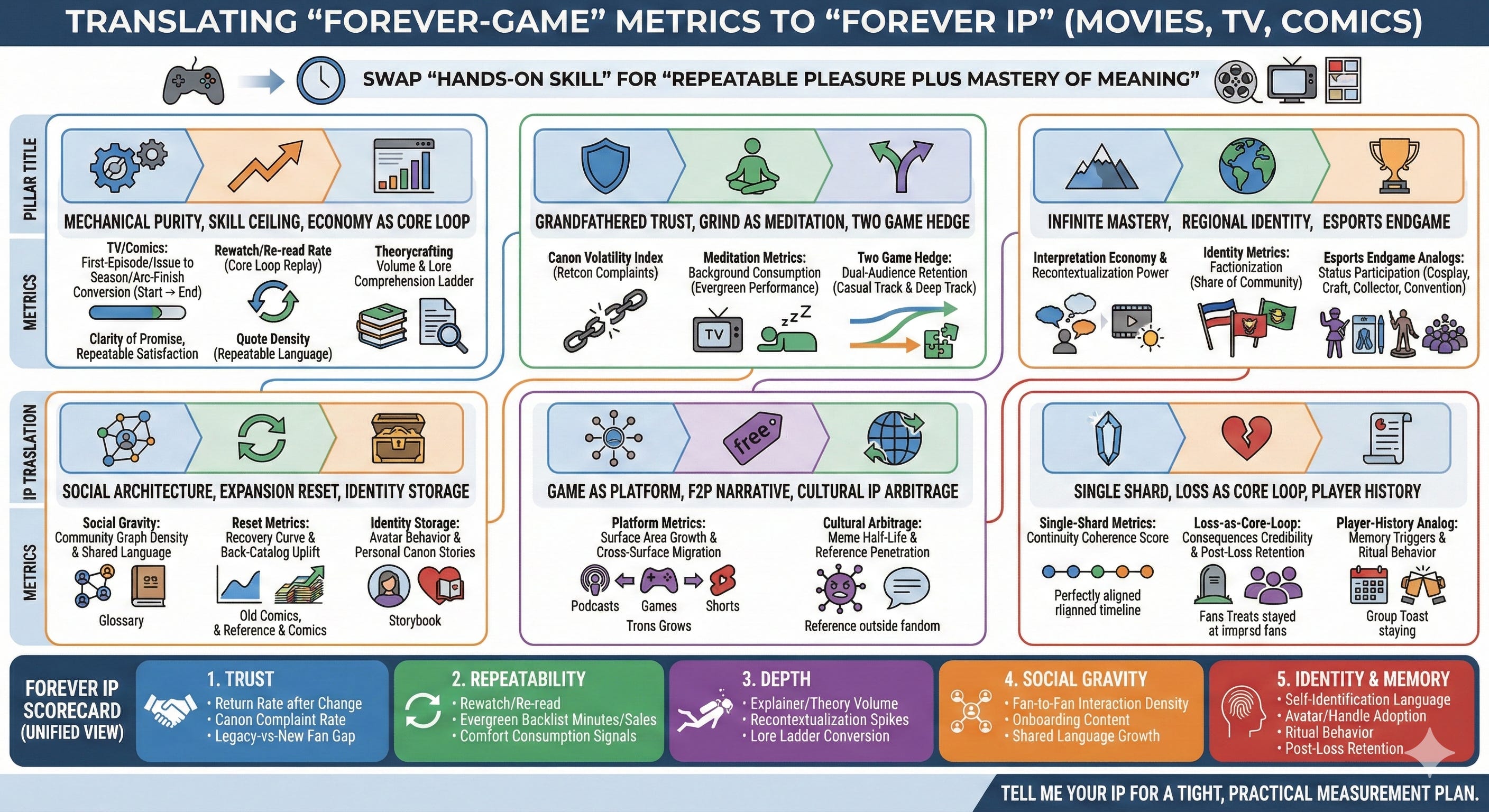
I‘m always looking for insight from adjacent forms of entertainment I can apply to my own domain. Saw a cool info graphic about commonalities between forever games. Came up with some relevant bits you might consider when building your own IP.
1. Trust
Fans stick around when they believe you’re not going to yank the rug out from under them.
What that means: Keep your rules stable, your tone stable, your character choices honest. Surprise people if you want, but earn it.
Quick gut-check: If someone says “I don’t know if any of this matters,” you’re leaking trust.
2. People Enjoy Repeatable Pleasure
In games, people replay because the moment-to-moment feels good. In stories, people return because the experience satisfies every time.
What that means: Build a repeatable pleasure, not just a big twist. Give the audience a reason to hang out in the world.
Examples:
A detective doing detective work
A crew pulling heists
A squad solving weird problems every week
A character who always has to talk their way out
Quick gut-check: Can you describe what the audience gets to watch again and again, in one sentence?
3. People Can Keep Getting Better at Understanding It
In games, “skill ceiling” means you can always improve. In IP, it means there’s always more to notice.
What that means: Add layers. Give viewers something to learn. Make rewatching feel like it unlocks deeper meaning.
Ways to create layers:
Visual motifs that pay off later
Character secrets that reframe old scenes
World rules that reveal themselves in pieces
Themes that get sharper over time
Quick gut-check: Does second viewing feel richer than the first?
4. People Find Their People
Forever games build teams, rivals, mentors, shared language. Forever stories do the same thing through fandom.
What that means: Give the audience ways to identify and argue playfully. Factions, houses, philosophies, ships, moral camps, roles.
Quick gut-check: Do fans have labels for themselves yet?
5. People Store Their Life
This is the sneaky one.
The longest-lasting IP becomes a calendar, a memory bank, a personal history. People can remember who they were when they first found it, who they watched it with, what it got them through.
What that means: Let moments land emotionally. Let consequences count. Let characters change in ways that feel permanent.
Quick gut-check: Do fans talk about it like it “was there” for them?
Build With Intention
If you want your movie, show, or comic to have long legs, here’s what you’re actually building.
A clear promise. What experience are you selling, week after week? Not “it’s a sci-fi thriller.” More like: “Every episode, a smart person solves a dangerous mystery using a weird rule of the world.”
A repeatable engine. A forever story has a job the characters do, or a problem they reliably face. If you can’t name the engine, you’re relying on plot gasoline, and that tank can run dry.
A stable rulebook. Fans can handle shocking events. They struggle with “the rules changed because the writers wanted a new direction.”
On-ramps and deep dives. You want casual fans who can jump in and enjoy it. You want deep fans who want lore, patterns, and debates. The trick is feeding both without punishing either.
Consequences that matter. “Loss” isn’t just death. It’s cost. If choices cost something, fans invest. If nothing costs anything, they browse.
Five Metrics
Want to measure your own IP health? Ask yourself:
Do people come back after a risky choice?
Do people rewatch or reread parts for pleasure, not homework?
Are fans making explanations and theories?
Are fans forming groups and identities?
Do fans talk about personal memories tied to it?
If you’re getting “yes” on three or more, you’re building something with staying power.
Scribbler’s Takeaway
Trust plus repeatable pleasure plus community equals a story that can live for years.
Longevity isn’t content. Longevity is a relationship.