

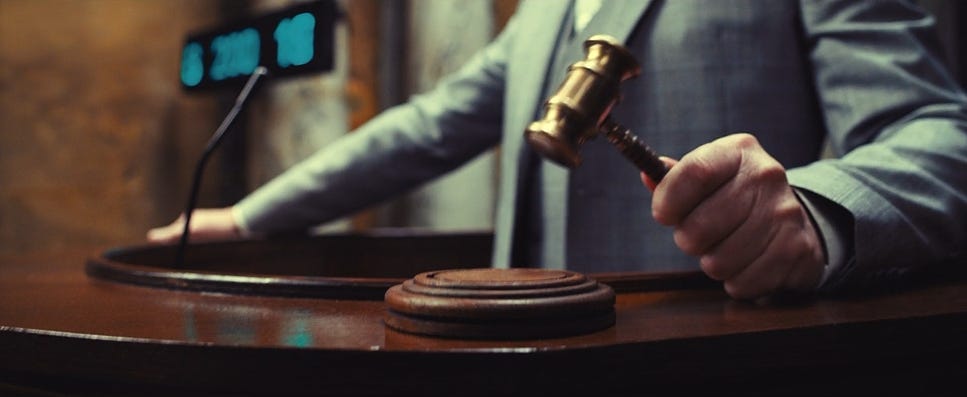
A mother sits in federal court, accused of stealing millions from the company she built. Her husband set her up, and her own daughter believes it. Then the doors swing open. A nine-year-old boy walks in holding a beat up blue backpack, points across the room, and tells the judge he knows exactly who framed his mom.
Great cold open. Wrong genre. Turns out it wasn’t a script at all. It ran as a thread on X, and WIRED traced the whole thing back to a source who never existed.
The scribbler behind it goes by BIGBEN, a 21-year-old stock trader in Nigeria who feeds prompts to Grok and ChatGPT for a living and collects a payout from X every two weeks for his trouble.
My ADD brain zeroed in on the structure before I’d even finished reading. Nobody in a scribbler’s room saw this coming. It didn’t come out of a studio note, it came out of a payment algorithm.
The Wound
Rob Cover, a professor at RMIT’s Digital Ethnography Research Centre, spent real time studying these threads and broke the shape down like he was diagramming one of my old beat sheets. Every one opens the same way.
An innocent person gets wrongfully fired, evicted, scammed, bumped from a seat that was rightfully theirs, or hauled in front of a judge who’s got it all wrong. Pick your injustice. The genre doesn’t care which one, as long as it stings.
Act One of every underdog story since fairy tales grew teeth.
The Object
Then comes the flip: a sealed document, a hidden will, a digital recorder planted in a cheating husband’s office that catches everything.
I’ve spent years chasing this exact kind of object, in the Alias room, Lost, Heroes, every room since. The gun in the drawer. The photograph in the folder. Chekhov didn’t invent the principle, he just wrote it down first.
BIGBEN’s version uses the same device and skips the work around it. The recorder shows up once, does its job, and vanishes. No one built the scene where it got planted, and no one earned the payoff. Call it a prop dressed up as a plant.
The Reckoning
Last beat, always. The underdog gets redeemed. The husband, the landlord, the airline passenger who wouldn’t give up seat 14C, they all get shamed in public, usually with a walk of humiliation built right into the visual.
Jenna Russell, a PhD candidate at the University of Maryland who studies AI scribbling, says the whole recipe is close to effortless to generate once a spammer knows the trope menu. Feed a model the injustice, the object, and the humiliation, and it hands back the dopamine hit fully assembled.
Call the whole three-beat machine the Grievance Engine. It only needs three moving parts, and none of them are original.
The Grievance Engine is my own Reel Four, compressed into ninety seconds and running on a phone. It’s the WANT framework stripped for parts. The people running these threads, out of Nigeria or out of the bot farm X sued in Hanoi, didn’t invent story structure. They found the switch every professional storyteller’s been flipping for centuries and wired it straight to a payment API.
X pays for engagement, and the company knows exactly how easy that engagement is to fake wholesale. It sued eight Vietnamese nationals and twenty-five unnamed “John Does” in May 2025 for running the bot farms gaming this exact program.
Clear the bar and the money moves. A Premium subscription, 500 verified followers, five million impressions in three months. BIGBEN says his deposits run $500 to $700 every two weeks.
The Missing Job
Cover’s sonnet has three beats and nothing else. No subplot, no secondary character complicating things, no object planted three scenes early so the payoff lands. The husband is corrupt because the plot needs him corrupt. The judge exists to be wrong, then right, then gone. Every location is a courtroom, a plane, an office, generic enough to be nowhere in particular.
That gap still needs a professional. Haecceity, the specific texture that makes a place and a person feel like they exist outside the frame, comes from research, memory, and refusing to let a generic stand-in do a specific job.
A model hands you an underdog with zero effort. The exact make of the recorder, why the kid chose to hide it there, what it costs a nine-year-old to testify against his own father in open court, that part still takes a person paying attention. And it costs a hell of a lot more than a prompt.
The formula still works. Injustice, object, reckoning has been pulling audiences since long before anyone got paid for it in dollars, likes, or upvotes. It’s built on something true about how people process unfairness.
Examples
Ideas that borrow the Grievance Engine’s skeleton (injustice, object, reckoning) and pay the debt BIGBEN skipped. Each earns the payoff with a planted setup or a subplot.
The Recipe
Injustice: A line cook named Odalys gets fired from a high-end kitchen after her signature dish quietly reappears on the tasting menu under the executive chef’s name.
Object: A stained recipe card in her grandmother’s handwriting, the one step the chef got wrong because he copied it from a photo instead of learning it from her.
Reckoning: She opens a six-seat pop-up two blocks away using the real recipe, no lawsuit, no public callout, and the chef’s restaurant loses its best table to her by the second week.
The Earn: Write the scene where she first teaches that unwritten step to her own line cook, years before the theft. Without that plant, the card is just a prop.
The Claim
Injustice: An insurance adjuster named Everett denies his own mother’s hospital coverage, then recognizes the denial code from a pattern he’s flagged three times that month.
Object: A spreadsheet he’s been quietly building for eight months, unglamorous, full of denials that don’t match the plain language of the policy.
Reckoning: He testifies at a state insurance hearing, and the payoff lands because the audience has watched him lose sleep over it for six episodes first.
The Earn: A brother subplot where the sibling thinks Everett’s a coward for staying at the company this long. Somebody in the story has to be wrong about him for the reckoning to mean anything.
The Deed
Injustice: A farmer named Thanh loses forty acres to a boundary dispute his neighbor manufactured with a forged survey.
Object: An eighty-year-old irrigation ledger in his grandfather’s hand, proving the water rights predate the neighbor’s paperwork by three decades.
Reckoning: Thanh wins the case in chambers by walking his teenage daughter through the ledger’s water-share math, so she carries the knowledge forward regardless of the verdict.
The Earn: Haecceity lives in the ledger’s actual entries, specific dates, specific acre-feet, names of neighbors long dead. Not “an old document.”
The Tape
Injustice: A teacher named Priya gets suspended after a doctored clip of her classroom goes viral, days before her tenure vote.
Object: A backup recording from the school’s decade-old intercom system, the one nobody remembers still runs, catching the real exchange.
Reckoning: The student who doctored the clip has to sit across from her and explain why, and she has to decide whether to forgive him on camera or off it.
The Earn: Plant the intercom system in episode one as a running joke about broken PA announcements. By episode six it’s load-bearing.
The Season
Injustice: A minor-league pitcher gets cut two starts before a call-up, and the front office blames an injury history that doesn’t match his real medical file.
Object: His own file, pulled through a records request, showing the team doctor altered a single date.
Reckoning: He pitches one more season in an independent league instead of getting reinstated. The front office quietly changes its documentation policy after the file goes public, a change he’ll never get personal credit for.
The Earn: The unearned version fixes everything for the underdog. Real craft can leave the call-up gone and let that be the point.
Notice the pattern. Every reckoning here costs the protagonist something, or costs somebody else something specific, instead of resolving clean.