

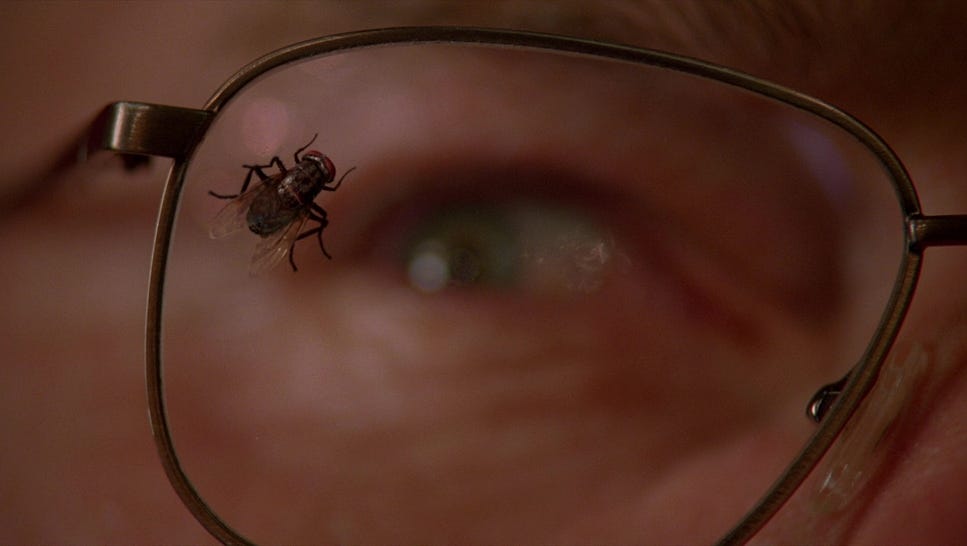
The bottle episode is a pressure test for character. Scribble a scene or build a single-map mission, the test doesn’t change.
A fly won’t die. A suitcase won’t close. The West Wing goes into lockdown and nobody’s allowed to leave the building.
Three different shows, three different genres. Breaking Bad’s “Fly,” an hour where Walt and Jesse chase an insect around the meth lab instead of cooking. Mad Men’s “The Suitcase,” where Don and Peggy get locked into an office overnight with a Samsonite pitch that won’t crack and a dead friend sitting between them. The West Wing’s “Isaac and Ishmael,” where a security lockdown traps the senior staff with a busload of touring high schoolers. Same move, every time.
The Studio’s Math
TV calls it the bottle episode. Leslie Stevens coined the term on The Outer Limits: the bottle show, pulling a show out of a bottle, the way a genie comes out of one. Scott Brazil, who ran The Shield, put it less kindly: “the sad little stepchild whose allowance is docked in order to buy big brother a new pair of sneaks.” Both men were talking about money. Fewer sets. Fewer locations. Fewer new faces to light, dress, and pay. A bottle episode buys the rest of the season room to breathe.
That’s the studio’s math. A scribbler wants something else out of the same hour.
The Room Does the Work
I’ve sat in the room for bottle episodes more than once. Alias. Lost. Heroes. American Gods, found its own version of the same play. The assignment always starts as a budget problem. It never stays one. Take the new location off the table. Take the new suspect walking through the door off the table. Take the case of the week off the table. What’s left is two or three people and whatever’s actually sitting between them. Now the hour has to be about that, because there’s nothing else left to shoot.
Lost leaned on this every season, because its whole format was built to avoid it. Six years of flashbacks, flash-forwards, and an ensemble scattered across a beach, a jungle, and a hatch that was never supposed to open. Every time the room bottlenecked that ensemble into a single location, the show landed a pairing the format usually kept apart. That’s what a bottle episode does once you’re inside it. A pressure chamber. Two characters, no exit, no subplot to cut away to, and the story has nowhere left to go but through them.
Confinement Is a Character Test
John August and Craig Mazin spent an episode of Scriptnotes, number 748, working the same territory from the movie side: one-room movies, the 12 Angry Men school of putting a whole story in a single set and refusing to leave it. The question they were circling is the only one that matters here.
What does confinement demand of character?
Pull the location and you pull the easiest tool out of a screen-scribbler’s kit: somewhere else to go. No new setting to smuggle in a plot beat. No hallway to walk down while the scene resets behind you. The characters stay in frame, the frame stays put, and eventually somebody says the thing, does the thing, or breaks.
A budget cut forces that constraint into existence. A showrunner exploits it to save a schedule. A scribbler worth the page rate turns it into the best hour of the season.
Same Trick, Different Rooms
The constraint doesn’t stay loyal to one medium. Drop a player into a single-map mission or a tight hub design and the trap is identical, just with a controller instead of a script page. There’s no new zone to unlock the tension for you and no cutscene detour to solve the pacing problem on your behalf. The mission has to generate its own pressure out of the space, the encounter design, and whatever the player’s character says and does inside it. Same demand a bottle episode makes of Don and Peggy in that office overnight. Same demand a one-room movie makes of whoever’s stuck inside it.
The format doesn’t care if you’re scribbling a teleplay, a screenplay, or a mission design doc. The constraint is the constraint. A room. A map. A cave. A storm. A night that doesn’t end until somebody finally says what they came to say.
Shut the doors. Watch what your characters do when there’s exit.