

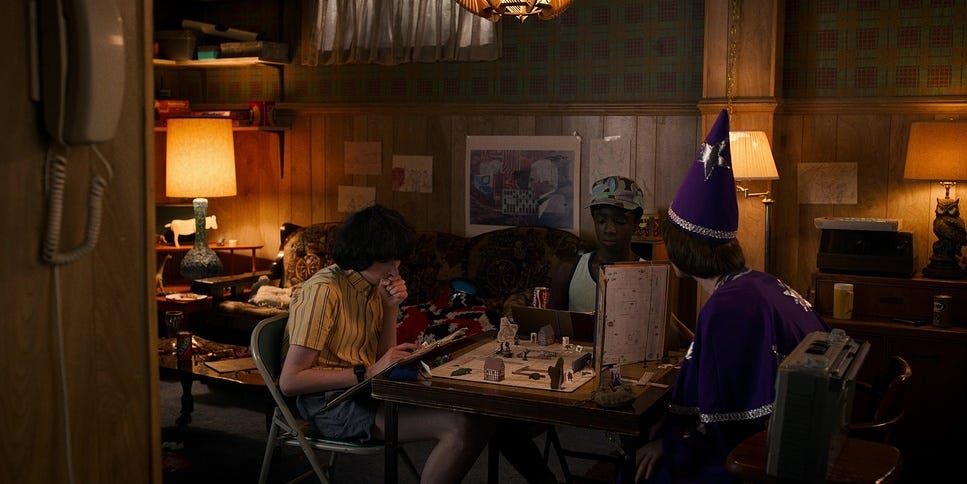
Dungeons and Dragons runs on a group of players voicing characters. A Game Master, called the Dungeon Master in D&D, plays the world back at them, and the dice settle what happens. No script. Everyone inventing at the table, out loud, in real time.
Brennan Lee Mulligan runs those tables for a living. He’s the GM behind the Dimension 20 series, and he trained at the Upright Citizen’s Brigade improv school in Los Angeles, where performers build a scene from nothing but attention and instinct.
A note he gives players has been circulating through the tabletop world, and it turns out to be a great note about scenes.
Players who follow it swear it turned their characters from cardboard into people. He calls it “role play rocket fuel.”
The trick: Care about something. Form opinions about the people and places in front of you. Like, distrust, resent, and want.
Emily Axford puts the practical version another way. “Consciously care.” Decide what your character feels about the person across the table, then play that emotion.
Reads like acting advice.
This tabletop note and my screen scribbler’s craft are buddies. The thing that lets a player generate an opinion on demand is the same thing that will make your scenes breathe.
A character who wants something can’t stay neutral. The want does the work the personality gets credit for.
Tabletop Note As Scene Note
Weak players lack objectives.
They chill at the table waiting to be handed a personality, treating every NPC like a vending machine for the plot. Nothing lands because nothing is at stake. They don’t know what they want, so they don’t know how to feel about anything or anyone.
Watch what happens the second a want shows up. Things help them get the thing. Things block them from the thing. Human beings form opinions about both, instantly, without being told what to do.
You don’t invent the opinion. The want invents it for you.
Mulligan calls the player a single light source and each character a pane of stained glass. He doesn’t ask players to invent new psychology every campaign. They adjust emphasis, not identity. You don’t build a new soul. You turn the dials. More compassion here. More ambition there. A little more recklessness than you’d allow yourself IRL. The light stays constant. The want bends it.
A scribbler hands a character a want and watches the opinions assemble themselves around whatever helps or blocks it.
Wants Divide the World
Look at The Social Network.
Building Facebook is Mark’s strategy. His want runs underneath it: prove I’m worth something. Run the room through that lens. Erica rejected him. Harvard clubs won’t let him in. Winklevi look at him like cheap shoes. Eduardo should have his back and keeps flinching.
Three opinions, maybe four, and the scribbler invented none of them. They flare out of the want like sparks off a grinder. Every opinion traces to one source. Whatever helps him, Zuck embraces. Whatever blocks him becomes an enemy.
This gives you a diagnostic for any scene that feels flat. Ask:
What does every character in this scene have an opinion about?
When the answer is nobody, nobody in that scene wants anything. A room full of people who want nothing is a room with zero story oxygen. Actors will feel it before you do. You’ll get the classic notes — I don’t know what I’m playing. What’s my objective. What am I trying to get out of this person. What do I want.
No want, no opinion. No opinion, no behavior. No behavior, no scene.
Check both sides of the table. When only one person walks in with an agenda, you scribbled a speech with a witness.
Let the Audience Solve It
Screen scribblers and role players part ways at this bit.
A player voices the opinion out loud. That’s the game at the table, broadcasting feeling so everyone has something to build on.
A scribbler buries it. The audience wants to catch the want on its own. Watching someone solve the equation. Doing the math for them kills the lean-back enjoyment.
Let those opposing wants collide and keep the wanting unspoken.
In Jaws, Brody wants the beaches closed and Vaughn wants them open. Both men chase something that can’t share the same Fourth of July festivities. The scene catches fire because their wants are incompatible. Tension is opposing wants with nowhere to go.
Trust behavior to carry the truth. Michael volunteers to kill Sollozzo, and the whole family rearranges around a man they thought was the soft one. Rick puts Ilsa on the plane, and the choice says everything a speech would have ruined.
Nobody narrates their wants. The action reveals it, and the audience leans in.
Want generates opinion. Opinion generates action. Action generates story.
That thread runs under improv, roleplay, and screen scribbling. Actors, players, and audiences chase the same thing. People pursuing something they care about while somebody stands in their way.
Give your characters a WANT worth having and the opinions will introduce themselves.
Video inspiration: Brennan Lee Mulligan on roleplay rocket fuel