

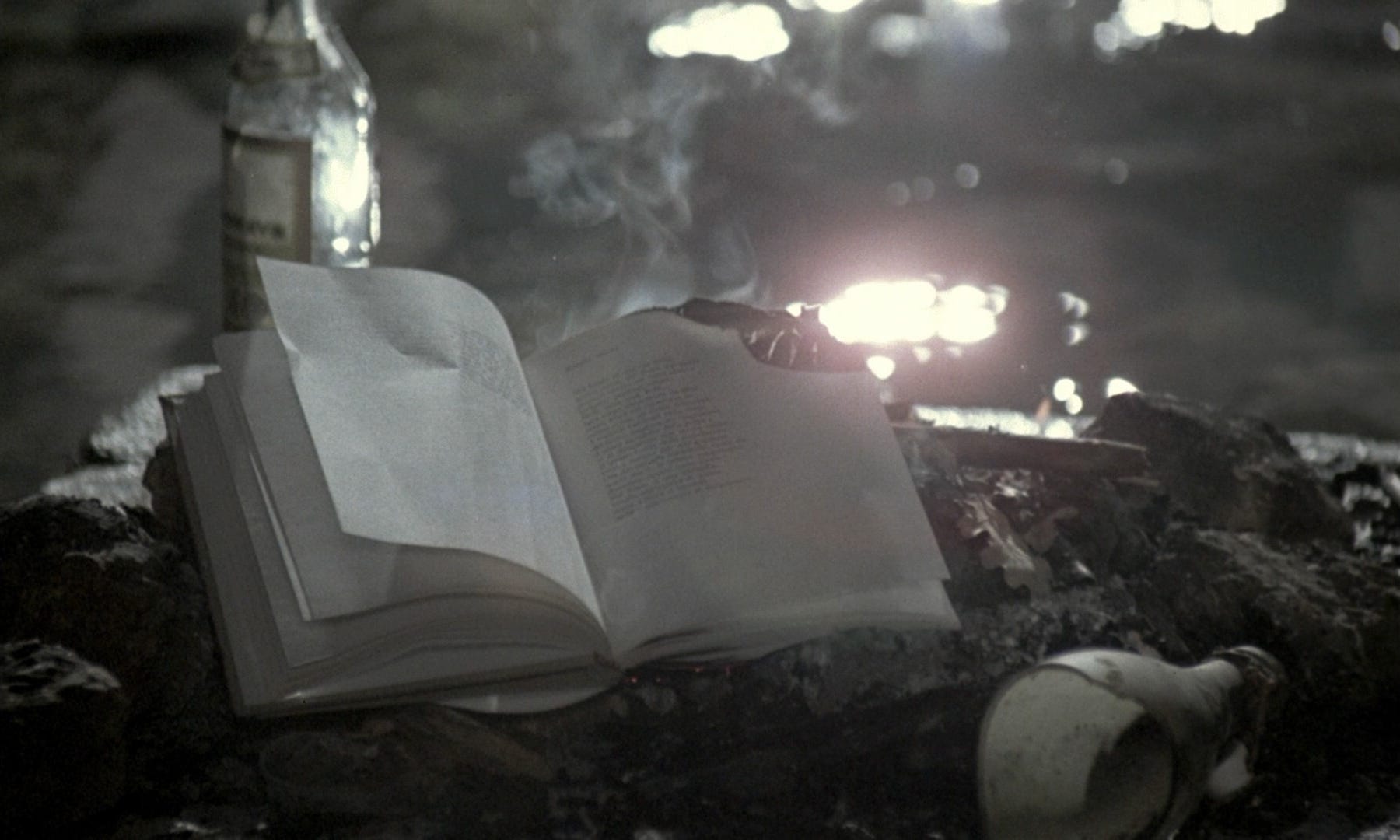
I meet a lot of people who want to scribble for a living. Young people picking a major. Adults planning a second act. Filmmakers with a screenplay in a drawer. Game devs who want to move into narrative. People who’ve carried a novel around for twenty years and finally put the damn thing on paper.
I’ve spent most of my life scribbling stories for TV, film, and games. Scribbling gave me a career, identity, and significant joy. I’m never going to tell somebody the urge to scribble is foolish.
These people deserve an honest description of the gig they’re chasing. Because professional scribbling runs on something we rarely say out loud —
— Somebody needs to read what’s been written. From start to finish.
Previously On
The economics were clear. A scribbler made a piece of text. A reader gave that text sustained attention. And maybe, potentially, once in a while, somewhere in the chain, money changed hands.
Sometimes the reader was a customer buying a book. An editor deciding whether to publish, an assistant writing coverage, agent weighing representation, a producer deciding whether to option.
Scribbler, reader, buyer. That was the food chain.
Even when the work was headed for another medium, the document mattered. Before a series became images and sound, somebody read the pilot. Before a movie hit a screen, somebody read the script. Before a game world became playable, somebody read the pitch, the bible, the design doc.
The page was the bridge to the final product.
People Still Want Stories
Let’s skip the lazy version of this argument. People haven’t stopped reading. They’ve absolutely not stopped wanting stories.
A 2025 Pew Research survey found 75 percent of American adults read all or part of at least one book in the previous year. Print stayed dominant at 64 percent. E-books hit 31 percent. Audiobooks reached 26 percent, more than double where they sat in 2011.
The book isn’t dead. Print didn’t vanish. Reading is still happening. The format, the intensity, and purpose have shifted.
The National Endowment for the Arts measures something narrower: voluntary reading, stripped of anything required for work or school. Its 2022 survey put adults who read at least one book at 48.5 percent, down from 52.7 in 2017 and 54.6 in 2012.
Narrow it to fiction and the slope steepens. Adults reading a novel or short story fell from 45.2 percent in 2012 to 37.6 percent in 2022. Lowest figure in the history of that survey.
Young readers point the same direction. In 2023, 14 percent of 13-year-olds said they read for fun almost every day. That number was 27 percent in 2012, and 2023 came in lower than any prior year.
These surveys measure different behaviors, so resist stacking them into a headline about nobody reading anymore. The useful conclusion is quieter and harder to dismiss. (It’s more like 20% of the population are doing 80% of the reading.)
Broad book consumption remains common. Sustained voluntary literary reading is getting rare.
People still ingest narrative via audiobooks, podcasts, games, video essays, feeds, streaming, comics, and short-form video. Scribbled prose runs through those forms. But arrives less often as a long uninterrupted encounter between a reader and a page.
The audience redistributed its attention.
The First Reader Was Always a Gatekeeper
Hollywood Executives have always had more material than hours. Scripts moved through assistants, agency readers, development departments, freelance coverage services. Somebody summarized the plot, listed strengths and weaknesses, named the comps, and rendered a verdict.
Pass. Consider. Recommend.
A script could die because the first reader was tired, green, distracted, or just not into it. That first reader was a person who had encountered the actual pages. That gig is now open to the machines.
Prescene. ScriptReader.AI. ScreenplayIQ. Callaia. RivetAI. Quilty. Or even gen-pop Claude and ChatGPT. These platforms ingest a screenplay and return a logline, synopsis, beat breakdown, character analysis, structural diagnosis, genre and market fit scoring, sometimes a production breakdown. In minutes, not days. They’re marketed straight at producers, agencies, and development teams as a way to process more material sans human attention.
We have no reliable data on how widely these tools are used across the industry. Anybody telling you every studio already feeds every submission into an AI is getting ahead of the evidence. Vendor testimonials prove the use is happening. Just not the prevalence.
The Writers Guild’s AI protections require employers to disclose when material given to a scribbler contains AI-generated content, including AI-generated notes. Machine feedback moved far enough into the professional conversation that the collective bargaining agreement needed language for it.
Old pipeline: scribbler, human reader, coverage, executive, buyer.
Emerging pipeline: scribbler, AI ingestion, structured summary or score, human skim, selective human read, buyer.
Coverage always reduced a screenplay to one individual’s report. The change is who or what is performing that first act of judgment.
One Machine’s Opinion
The first reader decides who gets a second look. The first report decides what moves up the chain. The first summary frames the executive’s expectations before the executive has touched a page.
A machine bends the final call without making it. It only needs to decide what deserves more human attention. That splits the audience for a piece of professional scribbling into four jobs.
The experiential reader enters the story and feels it. The analytical reader extracts plot, structure, character function, theme, comps. The commercial reader decides whether the thing can be sold. The metric reader measures completion, retention, conversion, engagement.
One editor or producer had done all four. Now the jobs get divided among software, assistants, algorithms, executives, and platforms. A machine analyzes the script. An assistant checks the report. An executive reads the summary. A platform predicts audience behavior. Only survivors get an actual uninterrupted human read.
Scribblers are producing more text than ever for a business that has fewer people reading it closely.
Scribbling for the Report
An AI coverage system gravitates toward what it can name and file. Who’s the protagonist. What do they want. Where’s the inciting incident. Where does act two start. What are the reversals. What genre is this. What does it resemble. Does the conflict escalate. Can the premise be stated cleanly.
Good questions. But what if scribblers begin optimizing for machine legibility. Protagonist states goal out loud. Structure gets more familiar. Genre easier to file. Dialogue explains what the system might otherwise miss. The project starts resembling its comps, because resemblance generates a more confident AI score.
The qualities most vulnerable to automated disinterest are the ones that make scribbling stick. Ambiguity. Subtext. Contradiction. Tonal instability. Delayed revelation. Meaning built out of omission. Characters who don’t understand their own motives. Structures that only make sense after the last scene.
Scribblers, agents, and execs will start anticipating what the system recognizes. We already know what that looks like. Headlines built for search engines. Songs built for streaming completion. Videos built for thumbnails. Episodes built for retention graphs.
Now imagine a screenplay built to get past the coverage.firewall. It’ll be easy to explain. Increasingly unnecessary to experience.
A New Pro Scribbler Path
I won’t tell anyone to stop scribbling. But we should stop training them for a version of the profession that’s evaporating.
The old promise: learn the craft, scribble an excellent manuscript, get representation, submit it to professional readers, let the quality open the next door. That path was never as clean or as meritocratic as advertised. But it did describe the basic aspiration.
The emerging career demands more.
Still scribble excellent work. Make it legible without flattening. Demonstrate its potential before anyone institutional approves of it. Move it across more than one form of audience experience.
Scribblers may need to think like originators, producers, publishers, and narrative designers.
The script might need a visual proof of concept. The novel might become an audiobook, a newsletter, a serialized podcast. The fictional world might arrive through short films, photographs, in-world documents, interactive fragments, a playable prototype.
None of that turns every novelist into a TikTok personality or forces every screen scribbler to build a transmedia franchise. It means the manuscript can’t be the only vessel carrying the idea.
The durable professional asset is the ability to create narrative value: characters, worlds, dramatic systems, emotional experiences, formats, communities, and intellectual property that survives a change in platform.
A New Toolbox
So what should somebody learn in 2026?
Scribble the pages. Foundation. No strategic framework rescues dull characters, generic choices, or lifeless prose.
Communicate value at different resolutions. A sentence, a page, a treatment, a pitch, the work itself. Every version carries the dramatic charge along with the information.
Learn how AI systems read you. Run the coverage via LLM. Study what the machine catches, what it misses, and what it confidently gets wrong. Treat the misunderstanding as intelligence about the pipeline. Never treat it as a note.
Prototype. Make something that lets another human experience the idea before you ask permission to build the whole thing.
Cross formats. Prose, audio, video, games, and visual storytelling are different instruments. Mastering all of them is optional. Knowing which best gets a particular story to its audience isn’t.
Learn the rights. In a fragmented media economy, ownership and licensing can outweigh the initial fee. Subscription platforms increasingly pay on pages read, completion, and engagement rather than copies sold, which ties income to attention.
Build evidence of interest. A small committed audience beats a large theoretical one described via Power Point deck.
Develop what can’t be produced by averaging everything that came before. Specific experience. Unfashionable curiosity. Strange combinations. Moral conviction. Taste. Whatever you can’t stop thinking about.
Machines find patterns. You supply reasons anybody should care.
Scarce Resource
We’re entering a period where more people will produce more scribbled material than at any point in huamn history.
AI generates articles, pitches, outlines, books, scripts, coverage, and notes at extraordinary speed. Every platform is filling with text. Every company can produce more of it. Every aspiring creator can generate an endless stack of competent pages.
Text is abundant. Deep human attention is scarce. The kind that lets a reader get immersed, surprised, unsettled, changed. Scarce among audiences and buyers and inside development companies.
Scarce everywhere scribblers had counted on finding readers.
The challenge facing the next generation runs past competing with machine-generated prose. They must make work that can survive automated analysis, platform metrics, and human speed skimming.
The next generation of pro scribes won’t win by out-writing the machines. But via finding ways to be worthy of human attention.