

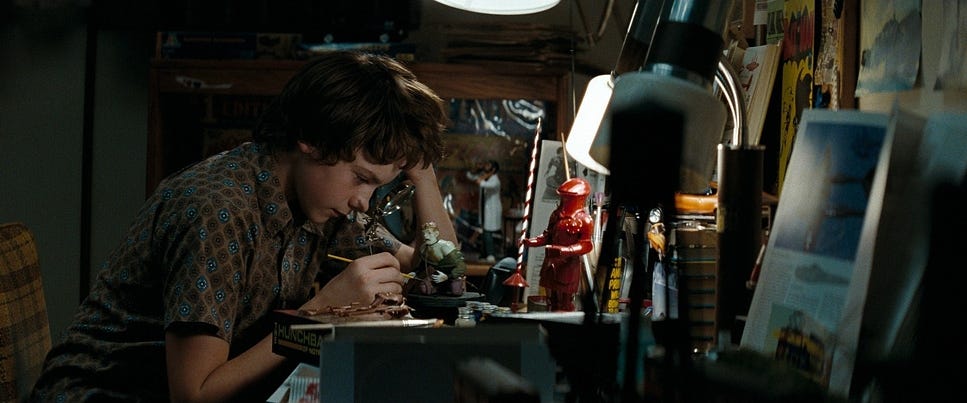
What might happen if you stopped hiding the process and started making it part of the show?
During Heroes, fans would dissect every frame online before the next episode aired. They’d map Hiro’s timeline on wikis, argue about whether Sylar could steal Claire’s regeneration, build entire theories from a two-second background prop. Fans didn’t just want to watch the show. They wanted to be inside it.
That impulse hasn’t gone away. It’s only gotten louder.
Scribblers are figuring out something that took the video games industry years to learn: your audience doesn’t just want a finished product. They want to watch you build it.
AI tools are giving solo creators a way to make that process visible, entertaining, and participatory in ways that weren’t possible when everything happened behind closed doors in a Burbank bungalow.
The Delta Is the Content
Working on Alias and Lost with JJ Abrams taught me something I think about constantly. The showrunner’s job isn’t doing everything. It’s knowing what only you can do.
AI tools generate options. Lots of them. Fast. But the gap between what they spit out and what ends up in your script? That gap is where your taste lives. Your experience. Pattern recognition built from years of breaking stories and watching scenes die in the edit bay.
That gap can be fascinating to watch.
People are drawn to it for the same reason they might watch directors’ commentaries or read about how Coppola almost got fired from The Godfather. The struggle is interesting.
Show your audience the raw output. Show them what you kept, what you killed, and what you changed. Show them why. That delta between the machine’s suggestion and your creative instinct is your value proposition as a creator,
Let Them Into the Room
On VALORANT, player behavior and feedback directly influence how Riot develops new agents. Play patterns become data. Data becomes design. The players shape the thing they’re consuming, and that loop keeps them invested in ways that passive consumption never could.
Solo creators might run a version of this. Stream your process. Let your audience vote on which concept you develop next. Run contests where they suggest scenarios and you build something from the best ones. Turning your creative workflow into their creative playground.
This is a tweak on transmedia storytelling. Make iteration visible and fast enough to be entertaining in real time. You’re not asking people to wait months for a finished product. You’re bringing them along for the ride.
What This Could Look Like
Picture a game designer who streams their whole process. The audience shows up not because the tools are impressive but because the creator isn’t pretending what they do is magic. They’re showing the grind, the bad ideas, the moments where they discover something genuinely surprising and run with it.
Or a screen scribbler who might be running an AI-assisted room for their web series and voices each bot like they’re actual scribblers with opinions and bad habits.
“DialogueBot thinks everything should be a monologue. Just like every playwright I ever staffed.“ The audience feels like they’re watching real creative decisions get made. The bots become characters. The process becomes a show.
The Shift
For twenty years, the entertainment industry kept the process locked away. Scribble rooms were closed. Development was confidential. The audience got the finished product and nothing else.
That wall is coming down. Not because anything forced it, because audiences have been pulling at it for years. Fan wikis, behind-the-scenes content, director commentaries, making-of documentaries. People have always wanted to see how the thing gets made. Now solo creators have ways to make that process dramatic, participatory, and ongoing.
The future of creative work isn’t just about what you make. It’s about how visibly, how honestly, and how entertainingly you make it.
Your process can be a show. Give your audience a ticket.