The Rise of the Post-Cinema Studio: EDGLRD
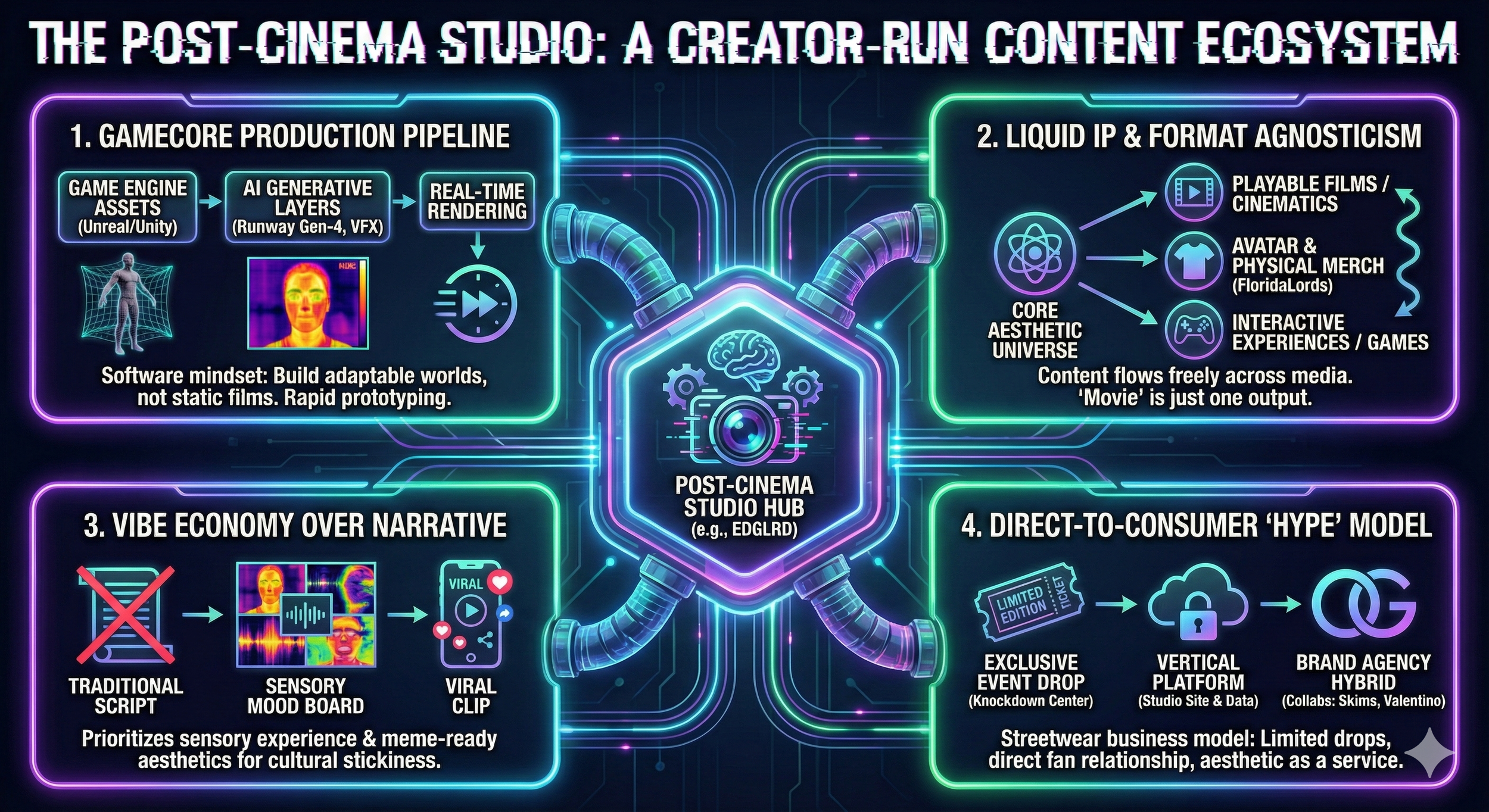
Indie OG Harmony Korine is prototyping the next era of creator-run content companies. EDGLRD is the first serious attempt to sketch what a Post-Cinema Studio might look like. When you look at the data points coming out of Aggro Dr1ft, Baby Invasion, EDGLRD's brand partnerships, and their actual workflow, a pattern starts forming.
We're watching a new operating model for screen-based creativity. And it looks nothing like the Hollywood ecosystem that raised most of us.
The Gamecore Production Pipeline
Korine and EDGLRD are treating production like software, not filmmaking.
Aggro Dr1ft, Baby Invasion, and the incoming Twinkle Twinkle aren't shot in the classic sense. They're assembled the same way game cinematics get assembled - with assets, rigs, shaders, and toolchains. Unreal and Unity sit at the center. Cameras are only one input. Most of the look gets generated through processing layers that mutate the world into a stylized experience.
A film is no longer a fixed piece of photography. It's a live asset library.
Their new Runway partnership matters because it eliminates historic friction. A face swap, a mask, a background patch, or a stylized look used to take weeks of VFX resources. Now it's a generative layer dropped in during finishing. That shifts the entire power structure of production.
Small teams now do work that once required a building full of specialists.
What this means: Studios will look more like indie game teams. Technical artists, procedural designers, and two or three creative leads working inside a game engine, spinning content at the rhythm of the internet. What used to take years collapses into months or weeks.
For young scribblers, your ideas no longer get trapped in the glacier-slow pipeline legacy Hollywood built around itself.
Liquid IP and Format Agnosticism
EDGLRD treats movies as one of many output formats. Everything is fluid.
Aggro Dr1ft functions as a film, a vibe reel, and a game-adjacent visual statement. Baby Invasion functions as short form content, art installation, meme fuel, and fashion campaign. Tamashika, the game, sits next to the film. FloridaLords, the clothing line, sits next to the game.
They're all pieces of the same aesthetic universe.
A hoodie worn by a human and a hoodie worn by an avatar now hold the same cultural weight. EDGLRD designs for both. That's where Gen Z and Gen Alpha already live.
Creator companies won't pitch "movies" or "shows" anymore. They'll pitch worlds. The money flows from all angles - streaming rights, in-game micro-transactions, physical merch. Narrative is only one part of the product.
For a solo creator, this is freedom. Your scribbles become assets, and your assets become a living ecosystem.
The Vibe Economy Over Narrative Structure
Korine is betting on sensory engagement over traditional plotting.
Aggro Dr1ft was polarizing because it ran on rhythm, texture, heat signatures, motion, and sound instead of classical structure. Baby Invasion leans into surreal, AI-bent imagery. These projects impact the senses first and the brain second.
It’s a vibe.
This mirrors how people watch content on TikTok, Instagram, and YouTube. Vibes travel faster than story beats.
EDGLRD's look is designed for memetic travel. Strange faces, thermal palettes, cursed intruders, weapon silhouettes, neon textures. These moments clip cleanly into short form. The content is built for culture, not critics.
Studios will chase cultural stickiness. Mood boards will get greenlit. Style sheets will matter as much as screenplays. The winners will be projects that audiences can remix, share, cosplay, and adopt as identity markers.
If you build worlds people want to wear, your work travels farther.
The Direct-to-Consumer Hype Model
EDGLRD behaves less like Warners and more like Supreme.
The Knockdown Center screening was treated like an exclusive release. The Venice presence played like a tech-meets-art activation. These are drops, not premieres.
EDGLRD is building its own ecosystem while still releasing on Apple and Amazon. That creates two layers. Broad reach on existing platforms, plus direct relationships with true fans through their own site. Owning your customer connection is the future of sustainability for creators.
EDGLRD funds its experiments by partnering with Skims, Marc Jacobs, and Valentino. This isn't just merch. It's aesthetic licensing. They function as their own brand agency.
Creator studios have the opportunity to merge entertainment, fashion, and social identity into a single offering. A24 is close, building an authentic cinema brand. EDGLRD is doing likewise, building a lifestyle-content brand for digital natives.
Where EDGLRD Sits in the New Creator Ecosystem
MSCHF: Drop culture, event-driven releases, physical and digital blending. But MSCHF focuses on prank objects, not sustained world building or long form storytelling.
A24: Brand identity, tastemaker aura, creator focused culture. But A24 still works inside the Hollywood timeline. EDGLRD builds the tech it needs to escape that timeline.
Runway: Generative tools and visual processing. But Runway is the toolmaker. EDGLRD is the studio bending those tools into full IP universes.
The Scribbler's Takeaway
EDGLRD points toward a future where creator companies look less like mini studios and more like digital fashion houses that happen to make films.
Content becomes modular. IP becomes liquid. Distribution becomes direct. Production becomes a software sprint. More agile development methodology than waterfall approach.
Creators who thrive will build worlds instead of sales pitches, asset libraries instead of linear scripts, and fan ecosystems instead of opening weekend expectations.
If you can think like a filmmaker, a game designer, and a streetwear tastemaker at the same time, you’ll have an invite to the next-gen creative party.