What if the Innovator Stops Innovating?
I’ve watched enough network regime changes to know the difference between a press release and what actually happens in the HQ. The press release says synergy (layoffs). While the building goes into survival mode for eighteen months as the employees figure out if they need to box up their desk.
Most of the podcast pundit chatter centers on antitrust. Will regulators let another media giant consolidate? Will the bundle reform, collapse, or reassemble in a new configuration?
If you believe we still live in a democracy where regulators are allowed to regulate, these are valid questions, but maybe they’re not the defining lens for what happens if Netflix or Paramount ends up controlling Warner Bros.
I’m more interested in Christensen’s innovator’s dilemma, the theory that explains how companies win through disruption and then struggle to keep disrupting once success introduces caution. Experiments start looking like distractions. Cannibalization becomes a career risk. The instinct that built the company begins to be treated as a threat to the company.
That frame matters for Netflix, the OG rule breaker, as they now sit in the role incumbents usually hold.
Paramount, the legacy bundle operator, may be trying to buy its way back to relevance while positioned near tech-forward firepower from the Ellison orbit, Oracle, and potentially TikTok-level distribution influence.
Both face the innovator’s dilemma — from opposite directions.
Netflix and the Disruptor’s Identity Crisis
As a SciFi nerd with ADD, I’m always hyped for what’s next. Story formats, interactivity, games bleeding into narrative, international shows breaking out in the U.S., Netflix spent the past decade proving skeptics wrong again and again. It normalized binge releases. Turned Korean dramas into water fountain fodder at High Schools across the country. Tested branching narrative before most studios were willing to spend.
That version of Netflix is why this innovation conversation matters. If Netflix becomes the owner of Warner Bros, they’ll have a dilemma.
Suddenly the rule breaker inherits the rules. A century of studio infrastructure, talent-first deal structures, political fiefdoms, and franchise stewardship come with the keys to HBO, DC, and Warner’s theatrical slate. The danger isn’t that Netflix cannot absorb it. The danger is Netflix absorbs it too well.
When you own global theatrical IP, experiments that undercut theatrical look irresponsible.
When you spend billions for a library, niche formats look too small to mention on earnings calls.
When you can mine DC for the next decade, chasing a weird Indonesian sci-fi drama looks like noise.
The dilemma shows up in the boardroom, not the branding.
— Do you shorten windows or protect them?
— Do you remix content or preserve the prestige aura?
— Do you keep funding unpredictable breakouts when predictable IP is the low hanging fruit?
The innovator’s dilemma predicts most companies answer those questions conservatively. The disruptor becomes the incumbent.
Paramount and the Temptation of Scale as Strategy
Paramount Skydance sits on the other side. By almost any metric, it is the incumbent model. Linear networks, syndication, affiliate fees, and global licensing still drive their engine.
Buying Warner solves a scale problem, not a format problem.
There is a wild card: the silicon valley asset map of Larry Ellison. Oracle as enterprise data heavyweight. Proximity to TikTok distribution. Tech leverage legacy studios never enjoyed.
This matters if that leverage translates into actual innovation.
Late adopters sometimes skip stages. They do not compete in the old race because they jump to a new one. Moving fast and breaking things. They can fail fast because they’re already failing slowly. They can take risks incumbents avoid because the incumbent position has already slipped.
But Paramount’s dilemma here is a mirror image to Netflix.
— Do you defend the bundle or reinvent it?
— Do you preserve windows or erase them?
— Do you chase the predictable library play, or ask what a studio looks like when TikTok and Unreal Engine can be part of your pipeline from day one?
If the combined company spends five years integrating catalogs and servicing debt, the answer is already decided. But if leadership treats the Ellison ecosystem as a springboard rather than inheritance, Paramount could upset the media applecart.
Same Theory, Opposite Stakes
Both Netflix and Paramount face Christensen’s warning for innovators, but the dilemma sits in separate rooms.
Netflix risks losing agility by inheriting studio stasis.
Paramount risks reinforcing its legacy reflex by acquiring even more legacy infrastructure.
— One risks slowing down because it suddenly scaled.
— The other risks staying slow because scaling is its strategy.
Why Scribblers Should Care
This isn’t just a business story, it’s a format story.
If Netflix owns Warner, gravity tilts toward global franchises and event programming. The mid-budget and experimental pockets where new forms are born could shrink.
If Paramount owns Warner, evolution toward creator-native, interactive, and algorithmic formats will likely move slowly, because those formats might jeopardize critical revenue.
While the podcast pundits debate the power of antitrust regs to prevent dominance. The innovator’s dilemma asks if the dominant players are even capable of change. The answer to that question could be what really determines the future of Hollywood.
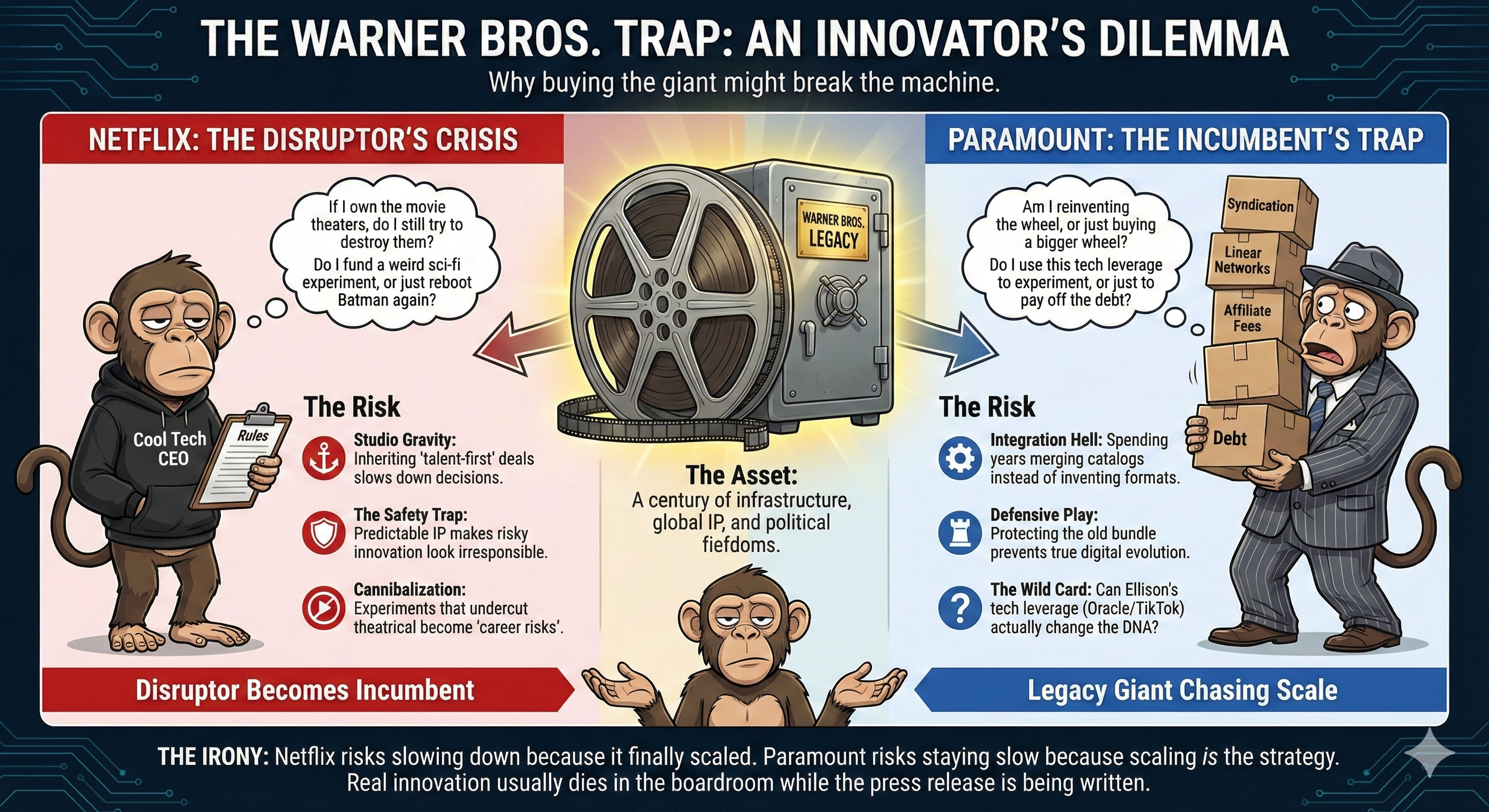
Infographic generated from post via Google’s Nano Banana Pro