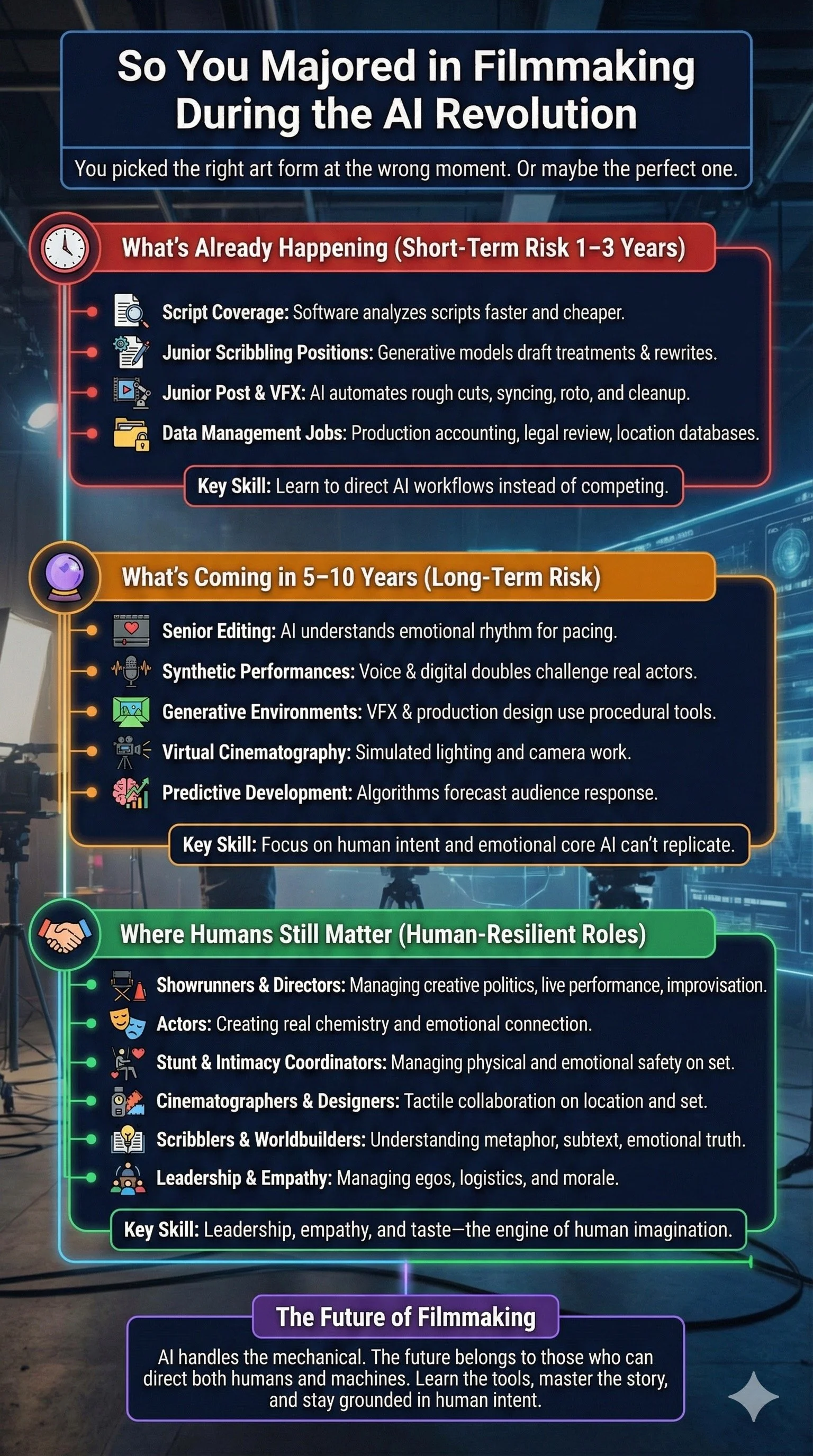
Film School During the AI Revolution
As I mentioned in a recent post, my son’s at SCAD studying film, and I’ve been watching him and his classmates navigate this weird inflection point where every tool they’re learning might be obsolete by graduation.
Script coverage that used to take a weekend now takes minutes. Junior editors are being replaced by software that syncs and assembles autonomously. The mechanical, pattern-based work is getting automated fast.
What survives comes down to judgment, collaboration, and emotional intelligence.
The jobs changing now aren’t abstract. They’re the entry-level gigs my son’s friends will compete for. Some of those positions won’t even exist in three years. But new ones will. The question is whether you’re building the skills those new roles demand.
What’s Already Happening
Script coverage is getting eaten alive by AI. Those story analyst gigs where you’d read 40 scripts a weekend and crank out coverage? Software does it faster and cheaper. Same with junior scribbling positions that used to polish dialogue or punch up scenes. Generative models can draft treatments and rewrites on command.
This plays out in post too. Junior editors who used to sync footage and build rough cuts are being replaced by AI that can assemble sequences autonomously. Even basic storyboard work for TV can be generated from prompts.
On the VFX side, all that roto and cleanup work that entry-level artists cut their teeth on? Automated. Anywhere the job was mostly data management, AI moved in fast.
The skill that matters now isn’t doing those tasks. It’s learning how to direct AI workflows instead of competing with them.
The people who figure that out first will have a serious edge.
What’s Coming
There’s a difference between AI that replaces steps inside a craft and AI that attempts to replace the craft itself. Right now we’re mostly seeing the first kind. But the second kind is coming.
AI isn’t just automating, now it’s starting to understand emotional rhythm, aesthetic composition, and story logic. It won’t just handle tasks. It’ll collaborate, then compete.
Senior editors might be surprised to find AI cutting scenes based on emotional pacing. Voice actors are already dealing with synthetic voices that sound disturbingly close to real performance. VFX supervisors are watching generative environments replace manual pipelines they spent decades mastering.
Producers and executives will lean on predictive models to drive development decisions. Imagine getting development notes optimized for audience retention curves instead of personal taste. Why trust your gut when the algorithm can forecast engagement by the minute?
The question isn’t whether AI will learn to edit or light. It’s whether we’ll call it filmmaking when it does. And who decides.
Where Humans Still Matter
When I was running American Gods or breaking story on Lost, the job wasn’t just mechanical. It was reading the room, managing egos, understanding what an actor could bring to the stage that wasn’t on the page. That stuff doesn’t automate.
Showrunners who guide story universes across seasons and manage creative politics. Directors on set handling live performance and improvisation. Actors creating real chemistry and emotional connection. Stunt coordinators making split-second safety calls. Cinematographers collaborating on location with light and composition that responds to the whims of the moment.
Producers handling logistics, diplomacy, and keeping morale up when everything’s on fire. Editors making creative choices about performance and pacing that comes from instinct, not data.
Costume designers, makeup artists, casting directors. All roles built on tactile collaboration, human intuition, recognizing something in a performance that can’t be quantified.
And scribblers. Worldbuilders. The folks who understand metaphor, subtext, emotional truth. Human imagination is still the engine.
AI will collaborate, then compete. But leadership, empathy, and taste will keep you stay in the room when it does. These are the skills that’ll still get you hired in ten years.
The skills that make the work worth doing.
What This Means for You
I’m not saying film school is pointless. I think it’s rad. My son’s learning craft that matters. But the after school game has changed. AI can handle the mechanical side now. The future will belong to filmmakers who can work with both humans and machines.
Learn the tools. Absolutely. Know how they work, where they fail, how to use them as collaborators. The tools will keep changing, but the audience won’t. They’ll still crave stories that feel like someone meant them.
Stay focused on what AI doesn’t do. Human intent. The reason you make something. The emotional core that makes audiences care.
That’s what separates a screen scribbler from a script generator. That’s what separates a director from some hack running prompts.
Film school during the AI revolution should be teaching collaboration over polish, intent over coverage, decision-making over execution, emotion and empathy for both page and stage.
If that’s what you’re learning, you’re not behind the curve. You’re ahead of it.
You’re studying filmmaking at the exact moment the definition of “making movies” is being rewritten. That’s not bad luck. That’s choosing to be in the room where the next chapter gets written.